
Our history

Founded in 1923 as the Society of Sussex Downsmen, the Friends of the South Downs is the only membership-based charity dedicated to the protection of the South Downs National Park.
The aftermath of the First World War brought with it an outbreak of unregulated building development around the South Downs which raised many concerns at both a local and national level.
The threat of unregulated development cast a shadow over the beautiful Downland landscape. In 1926 the Society acted to prevent development at Crowlink on the downland cliffs of Seven Sisters by purchasing the land and later donating it to the National Trust. That action prompted later land purchases by the trust and public bodies which protected the whole of the Seven Sisters.
During the 1930’s the Society reacted to further threats to the natural beauty of the Downs, including the use of motor vehicles on Downland tracks and plan to place electricity pylons across the area.


In the second world war the Downs became initially the frontline against a possible invasion and subsequently an area for preparation and training for the D Day landings. After the war it took several years to clear the Downs of surplus equipment and to repair damage to the landscape.
From the late 1940’s onwards the Society had to cope with different threats to the Downs. Town and country planning controls reduced the threat of undesirable development, but economic prosperity intensified pressure for housing and industrial development, road improvement schemes and mineral workings.
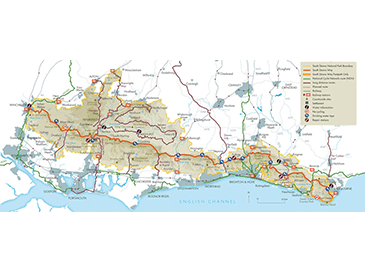
In 1992, the Society was invited to have a representative on the newly-formed Sussex Downs Conservation Board (SDCB), one of the forerunners of the later South Downs National Park Authority. In 2005 the SDCB merged with the East Hampshire AONB Joint Advisory Committee to form the South Downs Joint Committee. In the same year, the name of the Society was changed to “South Downs Society” to reflect the full extent of the Downs, and in 2017 to “Friends of the South Downs”.
In recent decades the Friends has given more attention to the culture of the South Downs, supporting two lottery-funded projects on the songs and folklore of the area.
The Friends celebrated its centenary in 2023 and continues to work vigorously to promote its objective of conserving and enhancing the natural beauty and amenities of the South Downs.

Past Achievements
Secret shore
On April 23rd 2016 – St Georges Day – singers from song workshops that were held in Littlehampton and Shoreham over the previous six months came together to record the sea shanties and sailors’ songs they had learnt. The project received a grant of nearly £50,000 to teach the traditional songs of the South Downs to people living across the region. You can still enjoy all the joy and inspiration of those two years by listening to a CD on which all those who joined the project can be heard singing their hearts out.
South Downs National Park
In 1999, following a review of national parks policy the Government declared support for a National Park in the South Downs – a long wait since 1949. During the 2003-5 and 2007-8 public consultation periods, we were a major advocate for a national park being confirmed. We were also strong supporters of the case for inclusion within its borders of the Western Weald, Lewes and Ditchling, and against the ‘narrow’ option. In 2011 the SDNP finally came into existence – on the basis of the ‘broad’ option, in part as a result of our lobbying. Our role then changed from being a major advocate for the creation of the National Park to becoming, as an independent, member-based organisation, a ‘critical friend’ of the Government-appointed statutory South Downs National Park Authority. This was formalised by us being appointed the local national park society for the South Downs and becoming part of the Campaign for National Parks. A new role for us but an important one.
Heyshott Down and the Devil’s Jumps
As pressure to convert ‘unimproved’ chalk Downland to agricultural use increased, so the risk of losing rich species of flora and fauna also increased. Therefore, the Society, with great help from local landowners, established chalk land reserves at Heyshott Down and the Devil’s Jumps.
Water trough and tap near Beeding, St Botolphs
With the increasing numbers of people enjoying countryside walking, the South Downs Way was approved as a National Trail in 1963 and opened in 1972. In 1987 it was extended westwards to Winchester.
The Society has responded to the creation, and increasing popularity, of the South Downs Way by identifying opportunities to establish practical ways to help walkers at particular points along the Way. The St Botolph’s water trough and tap are an example. Located by the footbridge over the Adur, it was opened in 1985. It is also a great example of the outstanding work of our volunteer District Officers – in this case Mrs Peggy Allen.
Chanctonbury Dewpond
As part of the Society’s contribution to European Conservation Year, the Dewpond at Chanctonbury, was completely cleared, giving a water depth of 5 feet at the centre and 50 feet across.
This important restoration work took a year to complete and its eye-catching appearance within 500 yards of the iconic Chanctonbury Ring resulted in us winning West Sussex County Council’s Award Scheme.
Signposting in West Sussex
We followed up the change to AONB status by successfully obtaining West Sussex County Council support for a major programme of signpost construction across the county.
This resulted in 325 such posts being erected.
National Parks and Access to the Countryside Act
The National Parks and Access to the Countryside Act 1949 was a landmark in countryside protection and conservation and from 1951 led to the creation of a number of National Parks across the UK. Unfortunately, even though the South Downs had long been proposed to become one of these National Parks, it was not then thought to meet the criteria. Instead, the Downs were designated as two Areas of Outstanding Natural Beauty; East Hampshire, confirmed in 1963, and Sussex Downs, confirmed in 1966.
Kingley Vale & Belle Tout Lighthouse
The Army was proposing to use as a permanent military training site 1,000 acres of land at Kingley Vale, the large area of grass Downland which includes one of Europe’s most impressive yew forests. We successfully lobbied for this proposal to be abandoned in 1947.
The Belle Tout Lighthouse had been badly damaged in the War by Canadian artillery fire – aiming at wooden tanks parked nearby! In 1947 it was returned to its former owner, Sir James Purves-Stewart (a Life Member of the Society), who handed it over to Eastbourne Corporation in the following year, so that restoration could take place.
The War Years
In the early stages of war, the nation was encouraged to ‘dig for victory’, and we influenced the choice of new land for food production, to prevent permanent disfigurement. In 1944 we were authorised by the regional planning authorities to use our network of District Officers to survey the South Downs, identifying areas particularly worthy of conservation in the post-war world. As the war came to an end in 1945, we successfully influenced Government to have the Army restore roads metalled for training purposes to their former chalk track status.
Crowlink Valley and The Sarsen Stone
Our first great challenge was the risk of major inappropriate development in 475 acres of the beautiful Crowlink Valley. The Society responded with a public appeal supported by massive publicity, enabling the purchase of Crowlink Valley for the use and enjoyment of all. This significant success was commemorated by the erection of the Sarsen Stone Monument, Flagstaff Point, Seven Sisters.
Founding of the Society
In the aftermath of the First World War, a spate of unregulated building development in the South Downs aroused concern at local and national level. This led to a handful of energetic and committed lovers of the countryside setting up the Society. Our inaugural meeting took place in Brighton Pavilion, with the hall filled to overflowing. The name of the Society of Sussex Downsmen was chosen, and from the beginning we were concerned to encourage not only personal experience of the South Downs through organised walks, but also campaigning for action to preserve this unique landscape.
More to explore

Board of Trustees
Our trustees each represent a variety of backgrounds and professions from conservation, academia, finance, legal and marketing.

Meet the team
The Friends is run by a Council of trustees elected by our members and by a team of three part-time staff.

Our history
Founded in 1923 as the Society of Sussex Downsmen, the Friends of the South Downs is the only membership-based charity dedicated to the protection of the South Downs National Park.

Public documents
Details of various documents relating to our work as well as opportunities to join walks, strolls, and events.

Contact Us
Our complete contact details. Get in touch by physical mail, email, phone, or send us a message directly from the website.