Posted on

New Heritage Website

Within weeks of our ‘South Downs Schools Living History Project’ starting in January 2020, we were hit by Covid and the first lockdown. Given that the focus of this project was for primary age children to interview the older people in their communities, this could have been a fatal blow, but through ingenuity and modern technology, we managed to overcome this huge and unexpected obstacle. We offered oral history training online and interviews were conducted online. It wasn’t the same, of course, but it allowed us to continue when other projects around the country were being suspended. Now, after two years, the South Downs Generations project launches the new heritage website.

Please follow this link to the evaluation form on the website that we hope people will complete and return. Your feedback will allow us to make improvements to the website and learn how to make future projects even better.

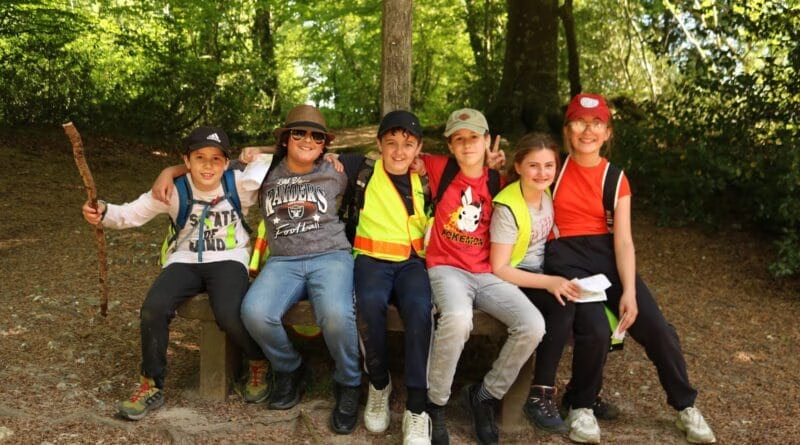
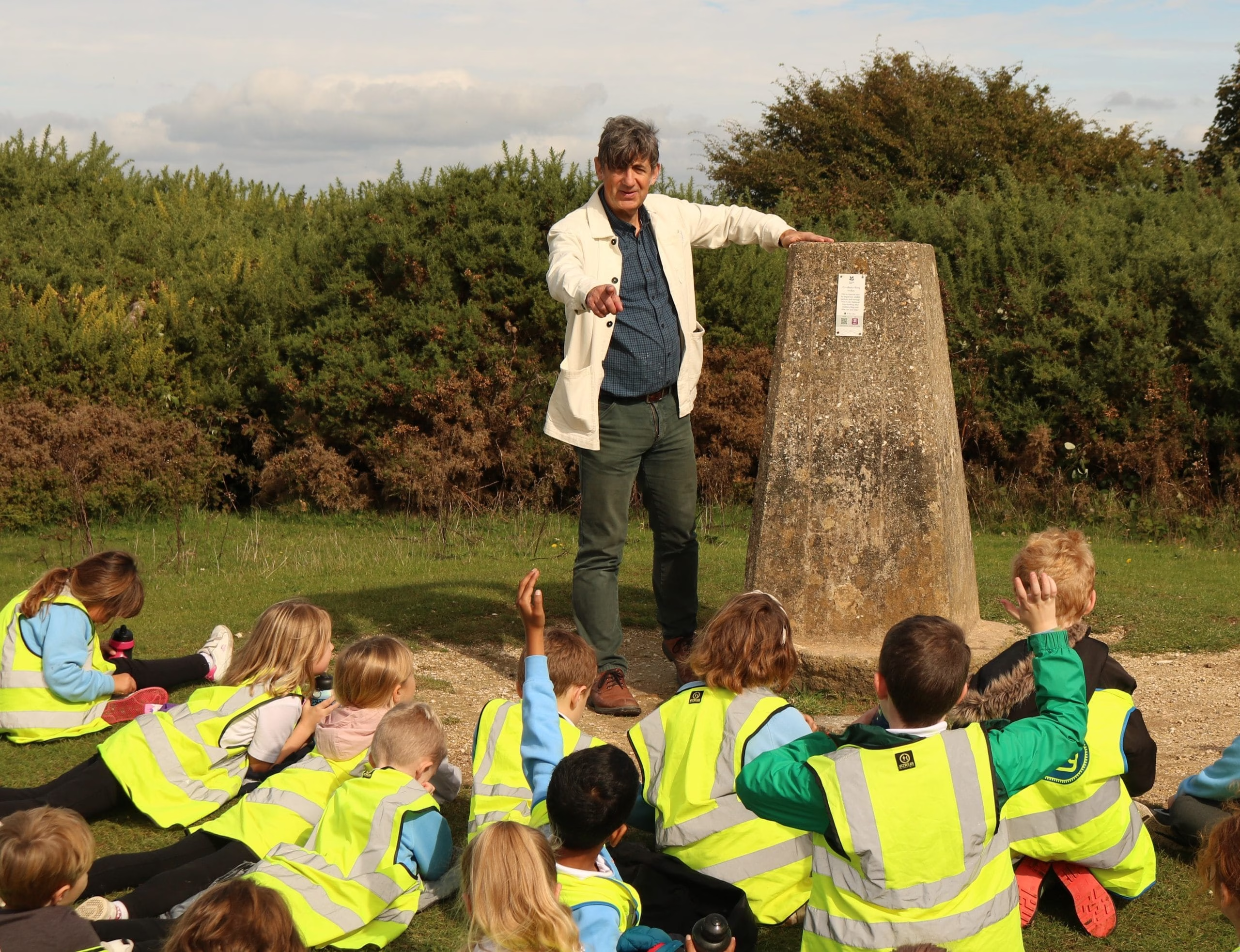
In between the lockdowns, project manager, Chris Hare, was able to visit our partner schools, including Shipley, Bury, Findon, and Chesswood (in Worthing). He gave talks to the children about South Downs history, from the earliest times to the coming of the railways. In the summer months, Chris took parties of school children on field trips to search out the archaeology of the South Downs landscape, with visits to Cissbury Ring and Highdown. There were also heritage walks around the villages where our partner schools are based, as Chris joined local teachers and their pupils in exploring the rich heritage to be found in our downland parishes.

Chris and cameraman, Chris Evans, went out to interview some of our older South Downs residents about their lives and the changes they have seen during their lifetimes. They interviewed all types of people from many different backgrounds, from Lord Egremont at Petworth to a lady living in a remote West Sussex farmhouse, still possessing only the minimum of modern amenities.

“It has been a fascinating experience,” Chris explains. “I have run many oral history projects over the last 20 years, but none so rewarding as this one. Together, these interviews provide the very ‘living history’ we were hoping to record with this project. To watch and listen to the interviews is to be taken back and led through time by knowledgeable and wise guides, from the 1930s to the present day.”

There are videos of all the interviews and all the school trips and talks on the new heritage website, www.southdownsgenerations.org.uk. We really hope that as many people as possible can watch the videos and then give us their feedback. The Friends of the South Downs wants the website to become a resource for all schools, and the public at large, throughout the South Downs and beyond.

Topics you can learn about from the new heritage website include –

  • Sussex Folklore, including articles about highwaymen and ‘rough music’
  • The changing face of the South Downs – farming and recreation
  • Archaeology on the Downs
  • Stories of gypsies and itinerants
  • Memories of country life, including folk singing
  • Memories from the Second World War, including plane crashes on the Downs
  • ‘Then and now’ slideshows, contrasting the images of 100 years ago with those of today
  • Mystery photographs – can you tell what they are?
  • The prophetic writings of many Sussex writers, such as Richard Jefferies, and Hilaire Belloc

There are also articles that draw on information to be found in school logbooks, some of which date back to the mid-Victorian period. You can read about the harsh discipline, the illnesses and diseases that were still killing children and making others gravely ill, in an era only just outside of living memory.

From our research, it would appear that winters really were colder in the past. The school log books often reveal how schools struggled to stay open following heavy falls of snow, and no winter was more harsh than the ‘dread snow tempest’ of January 1881. Several of our interviewees recall the bitterly cold winters of 1947 and 1963.

There really is so much to watch, listen, and read about on the website. Please go and have a look now, you will be pleased you did and please don’t forget to give us your feedback!

Chris Hare

South Downs Generations Project Manager

Posted on

The English Christmas Mummer’s Play

Normally, across Great Britain, from mid-November until Twelfth Night, you might be lucky enough to witness the performance of The English Christmas Mummer’s Play. “What is a Mummer?” you ask. Glynn Jones is going to give us “one man’s view”!

What I am about to share with you is “one man’s view” on the tradition of The English Christmas Mummer’s Play. This is my opinion, not a thoroughly researched thesis. I am not an academic or a scholar but I have been performing in Mummers’ plays for over twenty years and am currently the Captain of Sompting Tipteers. “What I do – I do plainly before your face and if you can’t believe that – it’s a very hard case”.

The following is a mixture of recorded history and plausible conjecture. I am going to give you some of the background to Mumming as I understand it and introduce you to the play that Sompting Tipteers perform.

What is a “Mummer”?     

Dating from the Mediaeval period, a Mummer is one who delivers a masked or disguised performance also known as Guisers or Rhymers, Pace-Eggers, Soulers, Galoshins and in Kent and Sussex-Tipteerers. The name, perhaps, came from the Greek word “Mommo”, meaning a mask, the wearing of which became popular at royal functions in the fourteenth century, the practice of such being termed as “Momerie”. A group of Mummers or Tipteerers is now known as a “Side” or “Team” and it is usually led and (loosely) organised by its Captain.
 
The Plays as we now know them

The plays performed today are mostly Hero Combat Tales – depicting battles between good and evil – light and darkness – life and death; they may have differing story lines and characters but the format is broadly similar. Traditionally, an all-male cast even for female characters. An heroic or villainous figure enters and grandly announces himself – he makes a boast about his prowess – this leads to a fight – one of the protagonists falls wounded or dead – the wounded man is then resurrected promptly by Father Christmas or by a doctor figure who makes much fuss about his skills and his fee. The actors divide into the “Principle” parts and the “Fancy” or smaller parts. A study of scripts gives the impression that Fancy parts were made up and added at will to give opportunities for others to take part and share the spoils. The Hero-Combat tradition with its boasts, battles and rebirth is represented in many cultures throughout the world, for instance, Katha Kali dancers in Kerela, southern India, perform a very similar tale in their travels around the rural villages.

There are three main theories regarding the origins of our plays.

Prehistoric Ritual.
Many say that Mumming, like Morris Dancing is not Folk entertainment but a survival of pre-Christian ritual activity. For these purposes we will define “ritual” as a ceremony carried out by a Shaman and/or his/her acolytes to bring about a desired outcome.

Three witches chanting Hubble Bubble Toil and Trouble around a steaming cauldron is one example, aboriginal people dancing to bring the approval of their gods in a forthcoming hunt or battle is another. Broadly we would describe pre-historic activities like these as pagan and as such unacceptable to the Christian Church.

Mediaeval Period – The Dark Ages
As the name suggests we have very poor records of life in this period. There are tantalising references to mummers from the mediaeval period but no surviving evidence of the nature of the performances other than the idea that they involved disguise and were intended to educate or entertain. It is therefore unsafe to assume that they were performing early versions of today’s hero–combat play or survivals of prehistoric rituals. It is reasonably certain that Mummers had no connection with the Mystery Plays of that period
 
Mid to Late Eighteenth Century
In the late 17th to Early 18th century European Commedia dell’arte spread from mainland Europe to England, it was an important milestone in the development of theatre as we know it and a source of inspiration for several genres including Pantomime and Punch and Judy. Said to be the first entirely professional form of theatre often performed in the open (Street Theatre) and funded by passing the hat. Commedia is a very physical type of theatre that uses dance, music, the slapstick, tumbling, acrobatics and buffoonery. The plays were based on a selection of Stock Characters, easily recognisable “Types” who the public loved to ridicule. One of these was El Dottore who represented a (supposedly) learned man but not necessarily a man of medicine. It would appear that disdain for “Experts” by the less well educated has a long history.

It is generally accepted that this was a major influence on the Mummers’ Play as we know it today. This type of theatre is likely to have been seen or heard about by common working people and the ideas and the style may have been adopted to put on their own entertainments.


Later Developments
Christmas was a lean time for many agricultural workers. There was little employment at that time of the year and not much to celebrate. It is suggested that the poorer members of the parish would put on an entertainment for those with something to spare. The plays would typically be performed at the grand private houses, the pubs and inns around the village, hence Father Christmas’s common opening line – In comes I Old Father Christmas, am I welcome or am I not?The players would be rewarded with a drink, something to eat or a few coins, all of which helped Christmas cheer. These folk would not have access to expensive theatrical make up and the easiest way for them to transform their appearance was to use soot or burnt cork. It is unfortunate that this has more recently been interpreted as “Blacking Up” or “Cultural Appropriation” and is now officially frowned upon when it certainly wasn’t the original intention.

Most rural villages in the South would have had their own play which was part of oral tradition; many of the players would have been illiterate and written scripts would be of little use. This has led to “mission creep” with ideas, lines and characters changing through time and from village to village. Adjoining villages would have very similar plays but the small differences would accumulate with distance and a play on the other side of the county would be recognisable but very different. Characters can change sides from good to evil and their lines become swapped around. The various elements of the play may stem from several sources, though these are hard to pin down.

Many of the people who the play had been handed down to had been killed in WW1, but a renewed interest in folk customs occurred and R.J. Sharp headed the revival in Sussex, forming the Boxgrove Tipteerers in 1927. Mr. Sharp first saw the play, revived by a Mr. Foard, when he was living in East Preston. Mr. Foard learned the play when he was a boy.  
Our Play

The play, currently, performed by Sompting Tipteers is not the Sompting Play. The Sompting play is said to have been recorded by a Mrs Pullenberry of Sompting in the late 1800s. The script survives but, for reasons unknown to us, we in fact perform the, very similar, Steyning Play. This is yet another mumming mystery.

Glynn Jones,

Trustee

Posted on

Strolling with the Romans

Would you like to go strolling with the Romans, along the road from Noviomagnus to Londinium? Stane Street, the Roman road that ran from Chichester (Noviomagnus) to London, was originally up to ten metres wide. Much of it is buried under modern roads following the same route.  The exact date of construction is uncertain; however, on the basis of archaeological finds, it was in use by 70 AD.

Stane Street photo by Judy Robinson

Stane Street shows that Roman roads were not always as straight as we used to believe.  A straight line alignment from London Bridge to Chichester would have required steep crossings of the North Downs, Greensand Ridge and South Downs and so after the first section, the road was designed to exploit a natural gap in the North Downs cut by the River Mole and to pass to the east of the high ground of Leith Hill, before following flatter land in the River Arun valley to Pulborough. Although at no point does the road lie more than 6 miles from the direct line.

The Stroll

There is something special about walking along a route that was constructed by Roman soldiers so long ago.  Along the way you get a great view of the Channel on the horizon, which seems to be remarkably close and at one point the Roman road cuts through an earlier, prehistoric linear earthwork .  The path descends into woodland and at the lowest point can be quite muddy until you start uphill again through the trees.  Its a moderate stroll but if you would like to extend it, the route connects to both the Monarch’s Way and the South Downs Way.

Bignor is also the location of a Roman Villa of domestic proportions where you can really get the feel of how people lived.  There are some good mosaics, a bath house and an example of a hypocaust (underfloor heating system). The site was discovered by George Tupper in 1811 when he uncovered the Summer dining room water basin after striking it with his plough.  

Today the Villa is still managed by the Tupper family under the control of Trustees.  It is open in the spring/summer months and has a tea room.  (check website for 2021 opening times). It well worth a visit and needs support, as it is an ongoing battle to preserve the site from the elements and damp etc.  You can see why the wealthy family who built it, chose the location, as it stands in a beautiful valley. Nowadays there is a vineyard right next door and as it is thought that the Romans introduced wine making into Britain, that seems very fitting.

What did the Romans ever do for us? Take a trip to this area and see for yourself.

Caroline Douglas, Trustee

Posted on

Poor Old Ivy

Ivy has a bad name. Many folk believe that it is a damaging parasite that should be removed from our trees. Unfortunately, this is mostly incorrect. Poor Old Ivy is not a parasite. It has its own root system penetrating the soil, from which it gains all its water and nutrients. To help it climb, it also has adventitious roots equipped with small suckers that it uses to cling to its host tree but they do not penetrate the bark. Ivy is just using the tree as a ladder to climb up from the forest floor towards the light and it does not strangle the tree in the process.

For the tree there are some downsides: the extra weight of the ivy on the branches of the tree and the windage of its foliage, which can act like a sail. A healthy tree can normally accommodate these extra loads but in exceptionally fierce weather, or in the case of a diseased tree, damage may occur. In addition, vigorous ivy growth around the tree trunk can produce a localised damp microclimate in which fungal growth can thrive. Tree Inspections become difficult with possible hazards being hidden from sight.
 
Buildings
Ivy can grow extremely rapidly, especially on buildings where there is no competing foliage. In a three-year project carried out by English Heritage in conjunction with Oxford University, to determine the true effects of ivy on buildings, the findings were positive. The study showed that ivy covered walls kept the inside of the building 15% warmer in the winter compared to other parts of the structure. In summer, the reverse was the case. The walls were recorded to be 36% cooler!
 
Ivy also helps to protect and preserve walls from frost, salt and pollution. The only time ivy is not beneficial and should be removed is on buildings that have existing structural damage or crumbling lime mortar because the ivy will creep into cracks and crevices, expanding with growth and increasing the damage and instability.
 
Value to wildlife
The plant also provides nest sites and shelter for insects, birds, bats and other small mammals. It is an important food plant for some butterfly and moth larvae such as holly blue, small dusty wave, angle shades and swallow-tailed moth.

Due to its autumn flowering, the ivy provides one of the latest sources of pollen, nectar and berries for insects and birds when little else is available.  Many insects including, but not limited to, honey bees, wasps, hornets, hoverflies, bumblebees, small tortoiseshells, peacock butterflies and red admirals rely on ivy’s nectar source to survive the late Autumn season. The nectar is an essential part of the ecosystem, providing the reserves needed by the adult red admiral butterfly to hibernate over-winter whilst the high fat content of the berries provides a nutritious food resource for redwings, fieldfares and our resident thrushes as well as blackcaps, blackbirds and wood pigeons. In total the plant can support at least 50 different species of wildlife throughout the year.

Human Health and Welfare
Ivy is known for its many health benefits, as it reduces mould and improves air quality.  This is a well-recognised topic at the moment due to a rise in people having respiratory problems. According to NASA, ivy is one of the top air purifying plants, removing toxins like
•        Benzene
•        Formaldehyde
•        Xylene
•        Toulene
 
Mythology and Symbolism
Ivy is commonly associated with Christmas, along with its counterpart Holly. As evergreen species, both plants were used to ‘ward off evil spirits’, with sprigs being picked and brought inside to keep house goblins at bay. It has also been a tradition to place a sprig of ivy within a bride’s bouquet, as it is thought that ivy symbolises fidelity, loyalty and support within a marriage.

Wearing a wreath of ivy leaves around the head was once said to prevent one from getting drunk. The Roman god Bacchus, the god of intoxication, was often depicted wearing a wreath of ivy and grapevines. Ivy was also a symbol of intellectual achievement in ancient Rome and wreaths were used to crown winners of poetry contests. Wreaths were also given to winning athletes in ancient Greece.
 
Think very, very carefully about the benefits of ivy before you decide whether to remove it.
 
Glynn Jones,
Trustee

Posted on

Coultershaw Beam Pump

The Coultershaw Beam Pump is located in the South Downs National Park near Petworth. It is part of the Coultershaw Heritage Site, run and maintained by volunteers from the Coultershaw Trust, a registered charity. It has a waterwheel, historic water pump, a state-of-the-art 21st century water turbine and historic buildings around the mill pond.  It is an important example of 18th century industrialisation in a rural area. It was the site of several corn mills from before 1086 up to 1973 and was on the routes of the Rother Navigation (1794-1888), the Petworth to Chichester Turnpike (1800-1877) and the Mid Sussex Railway to Petworth (1859-1966).  

The 3rd Earl of Egremont, a good friend of JMW Turner the artist, was interested in science and in improving his estates.  He obtained a private Act of Parliament to enable him to ‘make and maintain’ the River Rother Navigation, at his own expense. Construction work took place between 1791 and 1794, with the work at Coultershaw being completed by 1792. Here the river continued to flow through the watermill, with barges using the waterway and lock, a short distance to the south.

In those days many roads were poor and so where possible goods were taken from sea ports as far as possible along rivers and navigations. Coultershaw was once a very busy area with goods arriving by boats to the wharves, which were then loaded onto carts and taken along the turnpike. The tolls received for goods using the navigation were an important source of income for the Petworth Estate. The heyday of the navigation was from 1823 until 1859, when the arrival of the railway brought its commercial use to an end.

The Coultershaw Beam Pump was installed alongside the corn mill in 1782 to provide an extra water supply for Petworth House and the town. It was powered by a waterwheel, and pumped river water for 1½ miles to Petworth through a cast iron pipe. The water was stored in two cisterns; one on Lawn Hill for Petworth House, and the other in Grove Street to serve the town. The Beam Pump was capable of delivering up to 20,000 gallons of water a day to Petworth. In 1839, as well as Petworth House, the Beam Pump was supplying water to 7 public stopcocks and 137 private taps owned by 69 people in the town. It survived after the last mill building was demolished in1973.  The water from the pump has now been diverted to the fountain just outside the Pump House.

In 2012 the Coultershaw Trust installed an Archimedes Screw turbine in one of the sluices, it uses water power to generate electricity.  The turbine normally operates for 24 hours a day and generates 70,000 KW hours of electricity per annum, which is exported to the National Grid,saving over 50 tonnes of carbon dioxide.  The project was largely funded by our Patron, the present Lord Egremont through the Leconfield Estate, with contributions from the South Downs Joint Committee (predecessor of the SDNP) and the Coultershaw Trust.

A visit to Coultershaw can be combined with a visit to Petworth House or historic Petworth town, where there are several pubs, cafes and restaurants. The excellent Badgers Pub is also nearby.

Caroline Douglas, Trustee

Posted on

Eton New Town

Update October 31, 2023: The proposed Eton New Town project, aiming to introduce up to 3,250 new homes in East Sussex, has been rejected by local planners. Lewes District Council has opted not to include this development, slated for land owned by Eton College near East Chiltington, in its local plan.

Eton New Town Barry Page Photographer
Photo courtesy of Don’t Urbanise The Downs by Barry Page Photographer

The council cited the site’s unsuitability and emphasized the need for smaller, more affordable housing options. The North Barnes Farm Partnership expressed deep disappointment, labeling the decision as misguided.

Council officials conducted a thorough assessment, concluding that the site fell short of meeting the necessary criteria. Zoe Nicholson, leader of the council from the Green Party, underlined the importance of sustainable development alongside the pressing need for additional housing.

Damon Turner of the North Barnes Farm Partnership voiced their disappointment, asserting that their proposal offered a comprehensive solution to housing, environmental, and climate challenges. The exclusion of North Barnes Farm is viewed as a setback for Lewes’ future development, according to the developer, prompting a careful consideration of the next steps.

On Thursday 9 November 2023, councillors will convene to discuss and potentially approve the next phase of public consultation on the local plan.

November 8, 2021: In recent years, the Government has changed national planning policies and how it calculates the numbers of homes each area should aim to provide. Lewes District Council is currently looking at the required revisions to its local plan which has now expired. Accordingly, it has issued a consultation document entitled in short “Issues and Options”. Recently, on one of the Society strolls, members took the opportunity to walk round the North Barns Farm area, sight of the proposed Eton New Town. If it went ahead it would have a profound impact on not only the views out from and into the South Downs.

As ever, one of the key components are the plans to meet the requirement for more housing. The initial findings were that, to meet the Government targets, 602 houses would need to be built per annum, compared to 385 houses per annum in the current plan. In the last year, 242 new houses were built. Consultations run until the end of 2023 and the plan should be finally agreed by 2025, for delivery from 2026, covering the period to 2040.

There are some severe restraints. The District is constricted by the sea to the south, the National Park and the proximity to the Ashdown Forest. Along the coast, infrastructure is poor, e.g., the congested A259, but also within the Low Weald. Yet these are the only areas where new housing development can be accommodated, unless it is tacked onto to the eastern parts of Burgess Hill and Haywards Heath, both of which are already subject to massive expansion, with the Northern Arc scheme of circa 3000 houses.

The coastal strip covers Seaford, Newhaven, Peacehaven and Telscombe. The Low Weald encompasses the villages of Barcombe, Broyle, the Chaileys, Cooksbridge, East Chiltington, Newick, Plumpton, Ringmer and Wivelsfield.

Another approach, as in other Districts, is the suggestion of an entirely new settlement. Hence, North Barnes Farm and the surrounding area near East Chiltington and Plumpton Green, which is owned by Eton College, has come forward as one of the options for the Eton New Town. This totals some 465 acres. Welbeck Land have worked up detailed proposals for a new live/work community to be created over 25 years with a phased “place making approach”. It is suggested the focus would be on agricultural and horticultural activities with the creation of 2750-3500 jobs and 25,000 to 30,000 sq. m. of “workspaces”.  If you drive around that area you will see this scheme is not popular with almost every house bearing a “No Eton New Town” poster.

All of this however has now been kicked into touch, as the new Secretary of State has called for a pause on the new Housing Bill. Included in these the proposals, as part of the drive for more housing, was a new formula, known as the standard method, to determine the required housing provision, based on population projections and local affordability data. That method gives the higher hosing targets above but may now be revised.

Pictured is a map showing the area under consideration at North Barnes. Here is a link to the map, illustrating just how big this development is. Recently on one of the Society strolls, members took the opportunity to walk round the area, which might be involved. If it went ahead, it would have a profound impact on views out from and into the Downs, which would be one of our concerns. The Bevern stream runs though land, which is an important spawning area for sea trout. As ever there are no zero cost options.

Patrick Haworth,
Trustee

Posted on

Pondtail Wood Albourne–SAVED!

Triumph after tragedy! You may remember about 5 years ago a new owner of Pondtail Wood in Albourne created a local controversy. Without appropriate permission, he created a new access track from the highway and clear felled a large area of this ancient woodland, dumping a large amount of building material in the cleared area. What an eyesore it was! Residents of Hurstpierpoint, Sayers Common, Poynings and Albourne, amongst others, were all closely involved in creating the action group that saved Pondtail Wood.

The Save Pondtail Wood Facebook page gives further details of both the destruction and campaign which also involved the Sussex Wildlife Trust

It proved very difficult for various technical reasons to put a stop to the illegal activity, but eventually the South Downs National Park Authority were successful through their enforcement team. The wood is in a “bubble” pushing out from the National Park and is some way from the Downs. Together with the Shaves Wood to the north, it hosts some rare butterfly species.

The wood was put up for sale by auction but needed urgent and very expensive remedial work. After 700 tons of illegally dumped waste were cleared, recovery commenced, which included planting 2000 new trees. Pondtail Wood is now in the safe hands of a local family who regard themselves as custodians of this wonderful part of the South Downs National Park. They have overseen the replanting and regrowth of the five acres, lost to illegal felling and the woodland has begun to recover beautifully.

Despite the terrible damage caused by the trucks and excavators, bluebells have started  once again to carpet the woodland and vast quantities of life have returned to the ponds and streams that had once been filled with tree stumps and rubble.

As well as visiting Canada Geese, a family of ducks now occupy the pond island and traditional native bred pigs nuzzle through the woodland floor. It has been a wonderful example of how with a little help, Mother Nature can fix even the worst damage caused by humans.

Works continue at the site and there are plans to install a borehole to help water the trees through the summer months (not needed this year!)

It is hoped in future to open the woods in future to anyone wanting to learn more about woodland craft and forest management. The wood is on the B2117 Muddles Wood road in Albourne more or less opposite Singing Hills Golf Club, before you reach Poynings Crossways coming from the east.

Posted on

National Parks and the Climate Emergency

The Campaign for National Parks, of which we are a member, produced a report in June entitled National Parks and the Climate Emergency. It starts with the premise that the climate crisis is the biggest global threat we’ve ever faced and sets out to examine what the National Park Authorities (NPAs) are currently doing and to identify further actions that they, Government and other stakeholders need to take.

Eastbourne Downs from Windover – photo by Richard Reed

There are 10 national parks in England, covering almost 10% of the country and three in Wales accounting for 20% of the country. In the Foreword, the CNP Chair, Janette Ward, declares: “With this report we want decision makers to understand the importance of ensuring our National Parks are fully equipped to combat climate change and contribute to achieving national and global targets for carbon reduction.”

The Report observes that “Many NPAs have now developed specific Climate Change Adaptation and Mitigation Strategies and are undertaking detailed studies to better understand the impacts on their Park”. The SDNPA have done just that. In March 2020, they adopted a Climate Change Strategy and Action Plan confirming a “commitment to address the climate and nature emergency” by:

  • Committing to the SDNPA becoming a ‘Net-Zero’ Organisation by 2030
  • Agreeing an action plan which includes a commitment to working with our constituent Local Authorities and other partners, in particular communities and landowners, to deliver actions that respond effectively to the climate and nature emergency
  • Committing to working towards the SDNP becoming ‘Net-Zero with Nature’ by 2040

As part of that exercise, the SDNPA produced three principal documents: a Strategy, an Action Plan and a 5-Year Programme.  Climate Change Adaptation Plan and Strategy – South Downs  National Park Authority . They make interesting reading, in particular, the 5-Year Programme. It marks an attempt to actually translate good intentions into positive action and sets targets by which the success or otherwise of the actions can be judged.

In early December 2020, National Parks England published four Delivery Plans defining key targets for the NPAs’ work. One of these was on Climate Leadership. They made a number of specific commitments, one of which was “leading by example, through achieving net zero NPAs by 2030, wherever possible”.  They identified actions to achieve this, including:

  • Securing additional funding to establish a consistent carbon budget baseline for all 10 National Parks
  • Employing a climate change officer in each NPA to coordinate data and lead delivery of the net zero plan
  • Promoting sustainable tourism and demonstrating the benefit of low carbon holiday destinations
  • Better communicating how changes in land use as a result of climate change might affect the landscape character of the National Parks
  • Advocating for changes to national policy that will “provide NPAs with the tools locally to deliver net zero”                          

Interestingly, the SDNPA is not proposing to employ a specific climate change officer as they take the view that it is an expertise that should extend across all their work streams. Having said that, their Landscape and Biodiversity Strategy Lead, Chris Fairbrother, is the convenor for the UK National Parks Climate Change group and helped produce their Delivery Plan on Climate Leadership.

This particular Delivery Plan does come in for some criticism from the CNP Report. The charge is that it is “largely aspirational and does not contain any specific milestones other than the net zero dates”. There is a suggestion that although it declares itself to be “rightly ambitious”, it could be more ambitious. There are more ambitious commitments from elsewhere in the public sector. For example, the York and North Yorkshire Local Industrial Strategy sets out an ambition for the area (which contains two national parks) to be carbon neutral by 2034 and then to become England’s first carbon negative economy by 2040. It will be hard for NPAs to argue that they are at the forefront of tackling the climate emergency unless they can demonstrate that they are at least matching such ambitions.

There is a suggestion too that if they want to demonstrate real leadership, the NPAs need to ask for more powers, responsibilities and resources and for wider changes to national policy in order to support such ambitions. For example, encouraging car-free visitors would be far easier if a national road pricing scheme was introduced and/or local bus services were organised in a way which ensured greater support for rural services.

It is clear that, by themselves, the NPAs can only achieve a limited amount. They own a very small proportion of the land in their respective Parks and they are not the transport authority. That significantly reduces their influence. The Glover Report did propose a pilot scheme for the Lake District NPA to be the strategic transport authority for its area and it is understood that two other NPAs are interested in being included in any such pilot. Thus far, the Government has been very slow to respond to Glover.

The CNP Report does identify good progress made by the NPAs but suggests room for improvement. It also emphasizes that more needs to be done by way of education and that there has to be an appreciation on the part of everyone, but particularly Government, that radical action is required urgently before we can start to tackle the crisis effectively. Please do read it if you have the time.

David Green, Trustee

Posted on

Benches Project Update

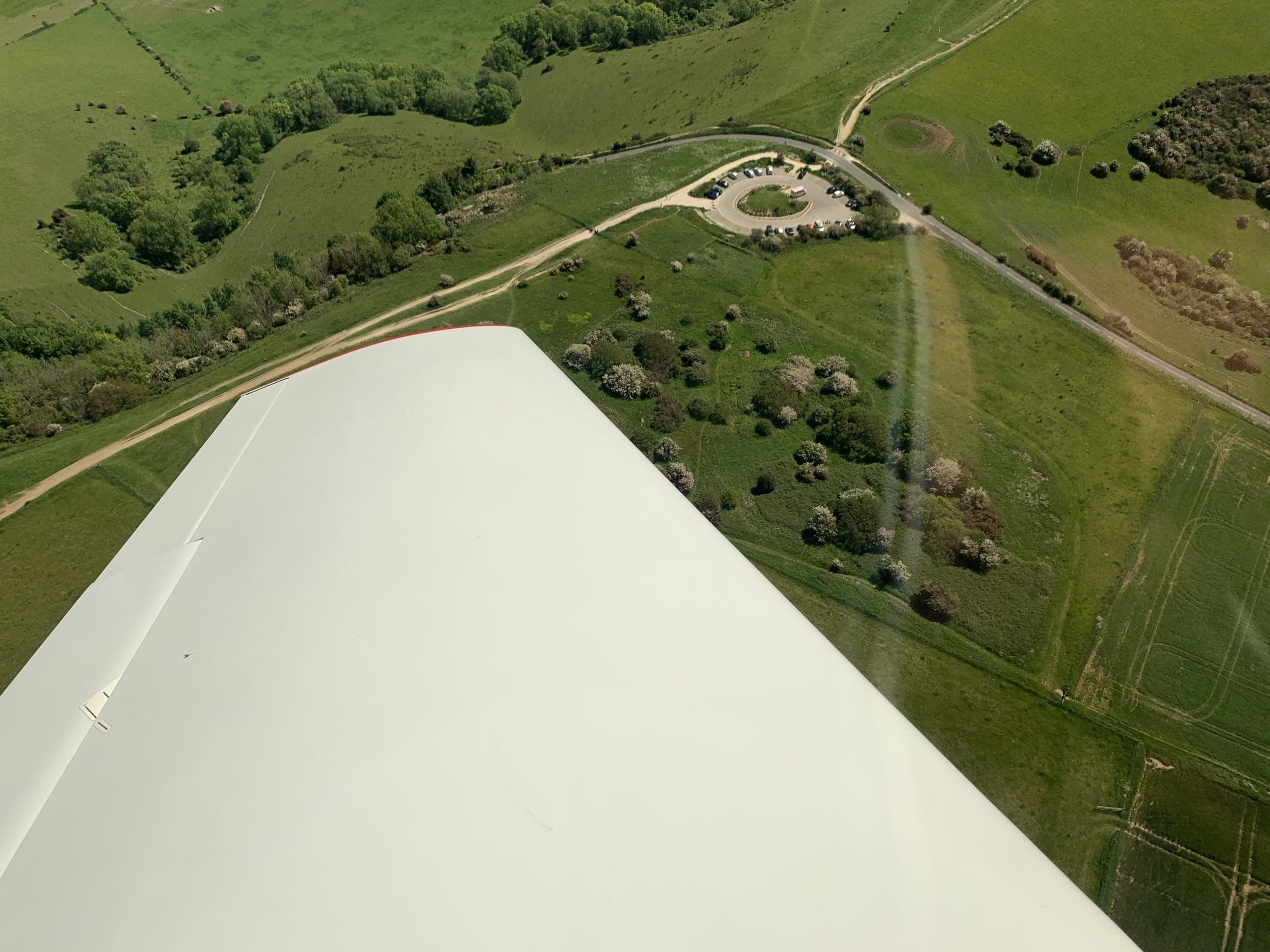
As you know, we are working to improve bench provision along the whole South Downs Way (SDW) because this was highlighted by members as being something that was sorely lacking. This Benches Project Update brings you the progress this project has made the past few months. The location shown in the photograph below is the potential site for one of our benches along the SDW. More will be revealed in an article in the September issue of The Downsman but we think many of you will recognise the spot.

Progress on finding sites was very much curtailed by the pandemic, as it was not possible to travel far to look for them but the good news is, that we now have permission for six benches with the first being already installed above Saddlescombe Farm on National Trust land.  We have three potential further sites identified, where I am working to contact owners and gain permission.  If all of these come through, we will have the entire length of the SDW from Winchester to Ditchling with bench provision.

When I started this project, I had no idea of the complexities that it would entail and it has been a steep learning curve. Firstly, finding sites at roughly five miles apart along the South Downs Way which are suitable, has been quite a challenge; we are trying to get a nice view in each case and the path has to be wide enough to comply with access regulations of the relevant District Council. On many occasions, a site that at first seemed ideal, has turned out to be too close to archaeological remains or have a landowner who will not give permission, etc.

Next, there is the task of tracking down the landowner, which surprisingly has proved to be a real detective job in some cases and several times I have been led to contact the wrong person.  Some parcels of land are not registered with the Land Registry, as they have not changed hands since its inception.  I have been working with the SDNP, their Rangers and the National Trust but also contacting Parish Councils and following up all sorts of other leads.

Another hold up has been the sourcing of sustainable supplies of English oak, which is in very short supply and this has led to delays in production. Chris Bain, our chain saw sculptor, has three more benches under commission at present and will hopefully track down the wood for them soon.  Then of course, the matters of insurance indemnity and health and safety have arisen. All new things for me to take on board.

The great news of this Benches Project Update is, that so far two benches have been sponsored by members, which is a tremendous boost to our funds for the project.  Sponsors of a whole bench can choose the hidden creature or plant native to the Downs, which is carved on them.  So far, we have an Adonis Blue butterfly at Saddlescombe and the two sponsored benches will have a milk thistle and two rambling roses. Both choices have sentimental significance to the sponsor, as we are not going to use commemorative plaques.

If any members have contacts for sourcing sustainable English Oak, please contact us using the button above and send us suggestions of sites for benches between Ditchling and Eastbourne for phase two!

Caroline Douglas,
Trustee


Aerial Photo by Brian Davies

Posted on

Looking at National Landscapes

The Glover Review promoted a shared Landscapes Service to give a bigger voice to the National Landscapes – designated National Parks and Areas of Outstanding Natural Beauty (AONBs). In case this becomes a reality, we are looking at other National Parks and AONBs in the UK in order to build links with them and their ‘Friends of’ groups. Join us as we begin this series by looking at Chichester Harbour.

Photo by Jeremy Bacon

Chichester Harbour AONB is a large natural harbour to the southwest of the city of Chichester on the river Solent. It is one of the few remaining undeveloped coastal areas in Southern England and remains relatively wild. Its wide expanses and intricate creeks are a major wildlife haven and among some of Britain’s most popular boating waters.

The harbour and surrounding land is managed by Chichester Harbour Conservancy. Its duty is the conservancy, maintenance and improvement of the Harbour and the Amenity Area for recreation and leisure, nature conservation and natural beauty. It is the statutory Harbour Authority and is responsible for the safety of navigation, the regulation of moorings, works and dredging, enforcement of harbour byelaws and the collection of dues and charges.

Harbour Dues paid by yachtsmen meet the cost of running the harbour, maintaining the navigation marks, controlling works and dredging and enforcing the byelaws.  Mooring charges meet the cost of maintaining and administering Conservancy moorings and mooring sites and contribute to the cost of running the Harbour.  Other income pays for environmental work such as tree planting, recording and surveying wildlife, footpath maintenance, providing information about the area and running the Education Centre.

Chichester Harbour is of national and international importance for landscape and nature conservation and is a special place for wildlife. A wide variety of animals, birds and other creatures live in and around the Harbour – some are very easy to spot, whereas others may be hidden in the intertidal mud or in the water, making them less obvious. 

Supporting the Conservancy, the Friends of Chichester Harbour was founded in 1987 as a focus for voluntary effort in the harbour, and to try to involve more people. The objectives of the new group were simple, “to provide a focus for and to encourage the development of voluntary activities in Chichester Harbour and its amenity area”. Initially, the emphasis was on practical work with the occasional social activity, such as boat trips and walks – a long way from the high-profile fund-raising organisation that now exists.

For example, the Friends of Chichester Harbour’s ‘Return of the Tern: Nature Recovery on the Southern Coastal Plain’ project has been awarded a grant of £182,300 from the Government’s £40 million second round of the Green Recovery Challenge Fund.

The project will focus on nature recovery along the south coast. It will also head inland west and east along wildlife corridors, to the foot of the South Downs. Placement of nine new tern rafts with remote-operated CCTV cameras at strategic harbour points is included in the project as well as conducting a small fish survey and reshingling Stakes Island and Ella Nore Spit and the appointment of a nature recovery officer.

Photo by Jeremy Bacon