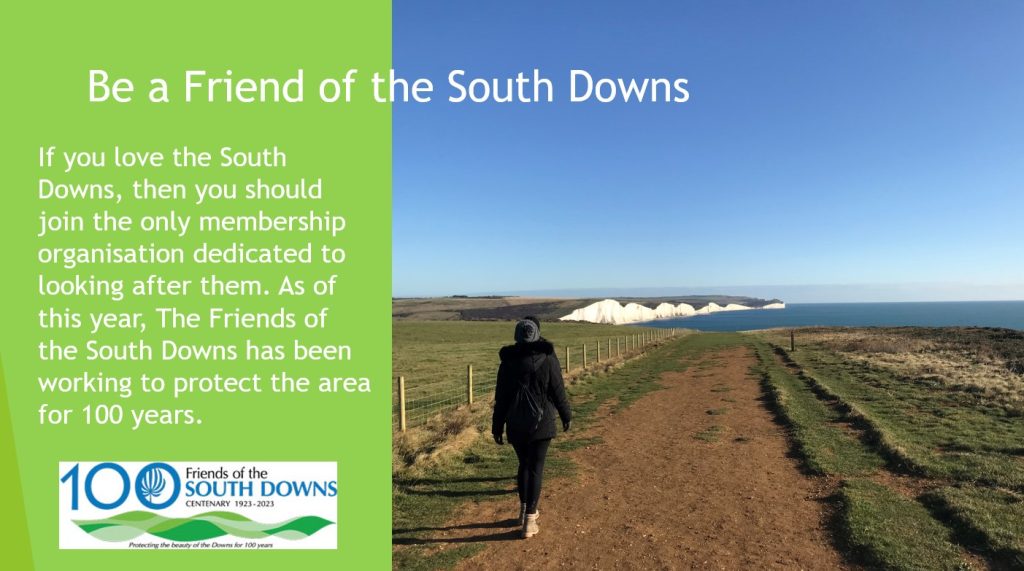
Celebrating our Centenary this year, we have some exciting events planned as well as funding some projects that will make a real difference on the Downs. We’d like to take this opportunity to thank all our members for their continued support and invite all our new friends to join us today. Be a Friend of the South Downs.
As a member, you have access to over 200 walks and strolls a year. Your membership helps support our team of District Officers who monitor planning applications throughout the South Downs National Park. Your membership also helps support our extensive educational programmes with schools.
The Friends of the South Downs has agreed a major programme of spending totalling over £100,000 in our Centenary year, to benefit the Downs in the short term and the long term. The Friends can spend this money because they are fortunate to have recently received two substantial legacies. You can help us make these legacies go even farther by supporting us. Be a friend.
Bigger Items of Spending in the Plan
£60,000 to the National Park Authority for the refurbishment of the iconic 18th century pump barn building at the Seven Sisters country park, which will be used to showcase the Downs for visitors and provide space for activities.
£20,000 for projects to encourage children to learn about and appreciate the South Downs. We’re running the projects with bodies like the National Park Authority and Youth Hostels Association. We’re aiming at children for groups who are less likely to visit the Downs. The plan is to teach them about the landscape and history, and most of all encourage them to appreciate and value the Downs.
Be a Friend and Support our Projects
providing attractive wooden benches, converting stiles to gates to improve access and placing information boards at significant locations.
helping make a path more accessible for people with limited mobility, planned location Devils Dyke.
Contributing to the cost of staging a play based on Hilaire Belloc’s famous book The Four Men about a walk across the Downs.
Financing prizes at Brighton University for academic work relevant to the South Downs.
Upcoming Centenary Events
7 August – Pulborough Stroll of 8 miles including complimentary lunch at the Society Offices
10 August – An exclusive stroll around Lord Egremont’s private woods at Flexham Park
18 August – a Sunset stroll to the Devils Jumps
16 September – Amberley Guided Village Tour and Afternoon Tea.
25 September – A Talk by Alastair Appleton (from BBC Escape to the Country) exploring wellness and mental wellbeing amidst the beauty and tranquillity of the South Downs.
The Centenary of the Friends of the South Downs coincides with 70 years since the death of Hilaire Belloc, one of Sussex’s greatest writers. So, staging two performances of Belloc’s beloved book The Four Men, now out of copyright, seems a perfect marriage of these two milestones, celebrating Hilaire Belloc and The Four Men.
Ann Feloy
Belloc’s farrago is set in 1902 at the time of Hallowe’en and is steeped in the beauty and mysticism of the landscape. To retain the spirit of the book, the performances are taking place Saturday and Sunday 28, 29 October 2023 at the medieval Sullington Tithe Barn at the foot of the Downs.
Belloc, as the character ‘Myself’, takes a journey on foot across the breadth of the county, from east to west, marvelling at the splendour of the South Downs and Sussex countryside. He encounters three companions along the way – the whimsical Poet, the rumbustious Sailor and wise, old Grizzlebeard. Together they meet some remarkable rural characters on their four-day, 92-mile long folk odyssey. They drink copious amounts of ale at the inns they stop at; they laugh, quarrel, tell tall tales and sing Sussex folk songs. They recount the legends of the Downs, describe their first loves and draw ever closer in friendship.
Playwright Ann Feloy’s stage adaptation of Belloc’s book was nominated as one of the top 10 plays at the Brighton Fringe Festival when it was first performed in 2010 and received a four-star review in The Stage when it was performed by the Conn Artists.
The dramatic reading this October of her stage play is being sponsored by the Friends of the South Downs. There will be special emphasis on the traditional folk songs and music of Belloc, fitting for celebrating Hilaire Belloc and The Four Men, alongside famous pieces of classical music by Sussex-inspired composers such as Vaughan Williams and Edward Elgar.
Beforehand, historian Chris Hare will lead a five-mile guided walk up onto the steep slopes near Sullington, over to Washington and then back in time for the performance, in order to see some of the sights mentioned in the book. He has recently published Hilaire Belloc – The Politics of Living which will be on sale.
There will also be a photographic exhibition of some of the places in the book by photographer Dean Sephton.
Bernard Smith writes in his book, Writers of Sussex, ‘Belloc loved Sussex as few other writers have loved her; he lived there for most of his 82 years, he tramped the length and breadth of the county, slept under her hedgerows, drank in her inns, sailed her coast and her rivers and wrote several incomparable books about her.’
Belloc lived for most of his 82 years in Sussex, growing up as a child in Slindon, and then settling at Shipley, near Horsham. He said of The Four Men, ‘I put my whole heart into that book but no one cares about it’.
Ann hopes the dramatic readings of her stage play will take the audience on a captivating journey that touches the soul, as Belloc no doubt intended.
One of the best ways we can safeguard the South Downs for the future is to encourage the interest of children in the hope that when they grow up, they will get to know and treasure the landscape and culture. We want to make sure that children have access to the countryside: no child left behind.
Some groups however have restricted access to our National Park, especially currently owing to the cost of living crisis, coupled with the pressures on school funding. Many children will miss out on a summer holiday with their family and others will miss those schools trips, which are so important for a child’s development.
Accordingly, we are making a donation of £5000 to the YHA programme known as No Child Left Behind, to give a short two-night break in the YHA South Downs Hostel near Lewes.
YHA is a national charity working across England and Wales and believe in the power of travel and adventure. Their aim is to connect people to each other, to nature and the outdoors, to culture and to heritage. This should improve physical health, mental wellbeing and life skills through the hostel experience. This is all in line with the recommendations from the Glover Report and nicely supplements our other work with children. This may not be ‘a night under the stars’ as Glover mentioned but a shared experience in a new environment with classmates in the natural world of the Downs.
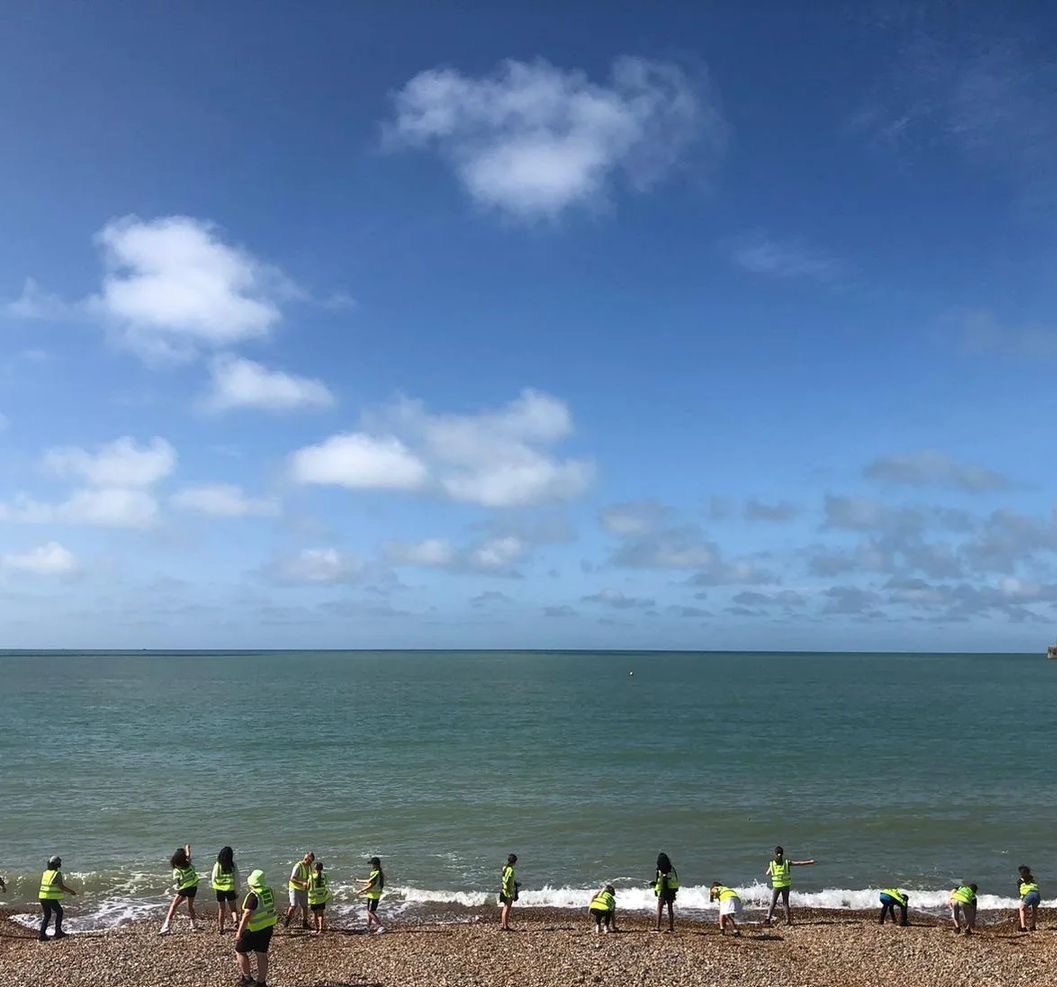
A school has been selected near Hastings and 56 Year 6 children with six leaders will enjoy this short holiday in mid-July. The school is in an area of social deprivation where parents are unlikely to be able to contribute to the cost and any gaps in funding are to be bridged with matched funding from the YHA.
Apart from fun activities such campfire singing, beach combing and shelter building, there will be sessions about the history and geology of the South Downs and Heritage Coast provided by So Sussex. We hope for some this will spark a lifelong love of the South Downs.
Hilaire Belloc was a prolific writer, who, over the course of fifty years, produced works of fiction, verse, political polemic, history, travelogue and religious tract. His book, The Path to Rome, is often cited as his most important work. But his renowned 1911 novel, The Four Men: A Farrago is a very different book. It is confined to the much smaller geographical area than The Path to Rome – the county of Sussex. Yet, at the same time it journeys much further than The Path to Rome – exploring the mystical and unseen world and the destiny of man. Belloc’s chosen vehicle for this odyssey is the chance meeting of four men.
One of our trustees and walks leader, David Green, has designed a linear walk called the ‘Belloc Way‘. The route draws inspiration from The Four Men. The novel recounts the journey of four men who embark on a 90-mile pilgrimage across Sussex, starting from Robertsbridge in the east and concluding at South Harting in the west. Along their path, they encounter various points of interest and engage in sharing stories, songs, jokes, and reflections on life, history, and culture. These travelling companions never reveal their real names but confer on each other descriptive epithets that most clearly describe their personalities.
The Belloc Way walk will take place over six days during the first two weeks of August 2023. Here’s a link to our Walks programme. While four committed regular walkers have pledged to complete the entire route, we warmly welcome other participants to join them for individual legs of the journey. This will provide an opportunity to learn more about Belloc’s remarkable life and his significant contributions to the literary world.
Each of the six stages of the Belloc Way are between 15 and 17 miles. Would you like to come along? We invite experienced walkers to join us for a taster walk on this journey. You may learn more about Hilaire Belloc and The Four Men and you will see the benefits of becoming a member of the Friends of the South Downs.
We are the only membership organisation dedicated to protecting the South Downs. We offer over 200 walks and strolls for varied fitness levels throughout the year. But we are more than just a walking club.
We make a difference on the South Downs:
With our body of District Officers throughout East Sussex, West Sussex and Hampshire who submit articulate, informed responses to planning applications which ensure that the Park is protected whilst allowing sensible projects
By raising the profile of the park through regular talks, publicity and programmes for children.
Through physical projects, including benches along the South Downs Way, replacing stiles with kissing gates, rebuilding part of the South Downs Way and planting trees
“It is rather wonderful that some of our youngest downlanders have been able to celebrate the Centenary of the Friends of the South Downs, by marking out ‘100’ on the greensward of the Downs. Bury School, nestling, as it does in the heart of the South Downs, has worked with FSD on two of our schools’ projects and are now taking part in our latest educational project called South Downs for All. Only last month, I accompanied some of the Year 5 and Year 6 children on an eight-mile walk over the downs from Slindon to Bury. A great school with a real commitment to sharing the joy of the South Downs with all their pupils.” Chris Hare, Project Manager
Our latest educational project, South Downs for All, is a programme aimed at bringing together eight South Down schools and the FSD to enable more children to enjoy the South Downs and learn about the heritage of this wonderful landscape. Chris Hare is also project manager of South Downs Generations, a unique partnership between FSD and four West Sussex Primary schools. That project brings together young and old to explore our common downland heritage.
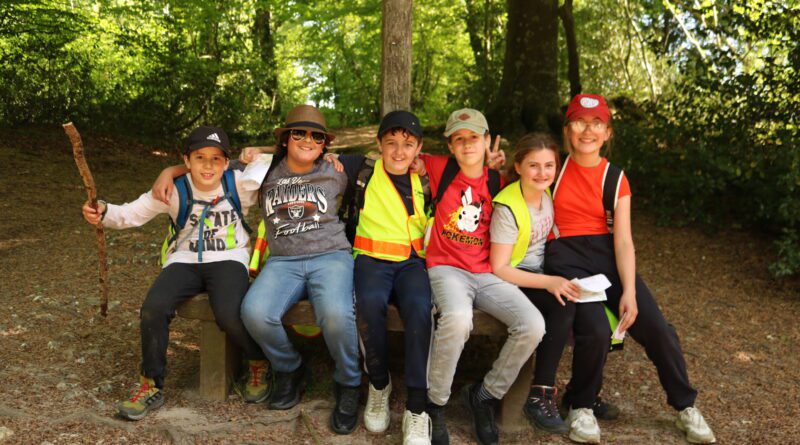
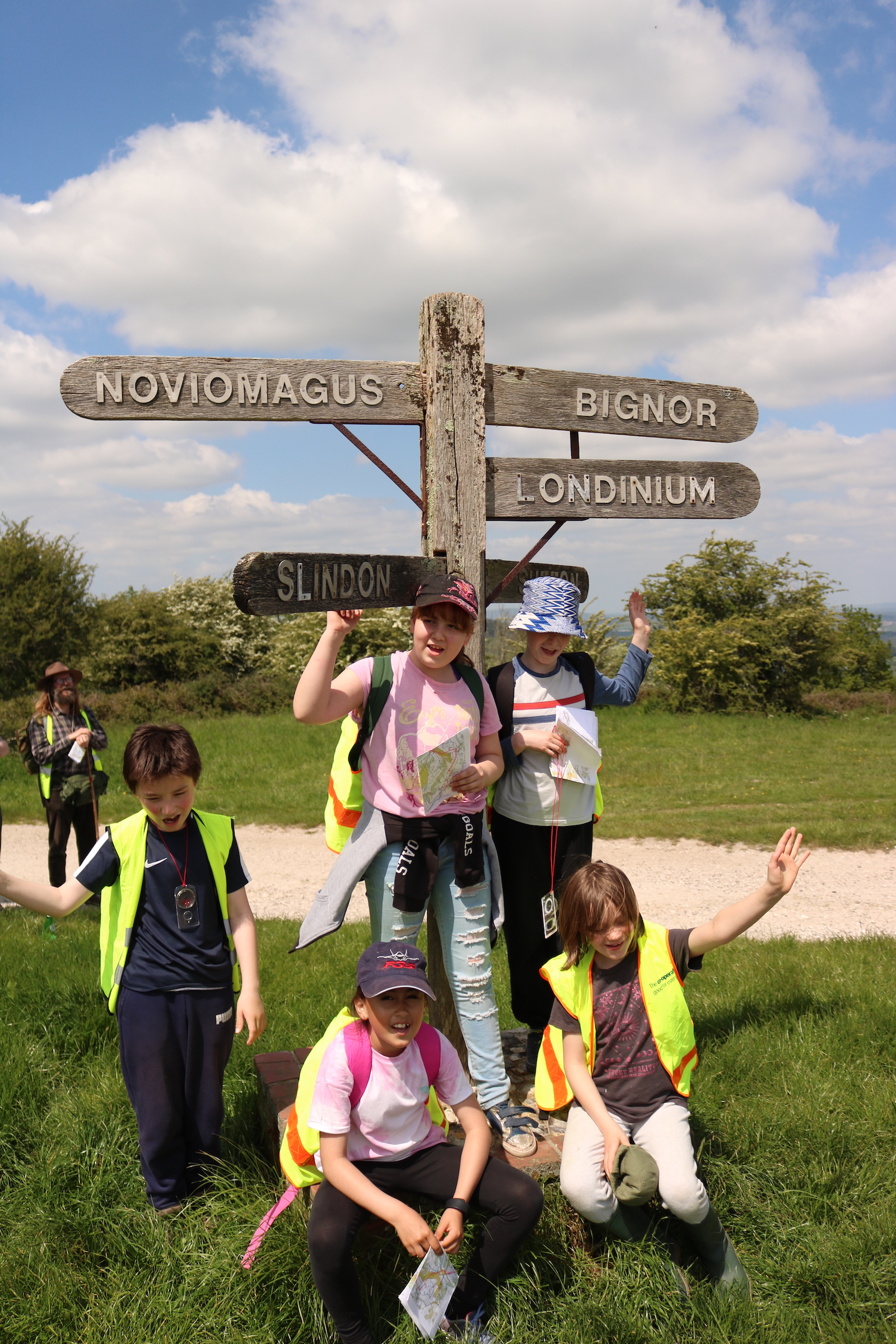
Year 5 and 6 children at Bury School proved their downland credentials by walking from Slindon to Bury, a distance of some 12 km. The day was perfect – warm but not too warm.
We walked by Slindon Folly on Nore Hill, built for the Countess of Newburgh over 200 years ago, and trod the route Roman soldiers took 2,000 years ago along a surviving stretch of Roman road at Stane Street, that once led all the way from Chichester to London.
There were plenty of stops, including one at Bignor Hill, where the fingerpost points to destinations written in the original Latin.
Finally, we descended Bignor Hill and came across a bubbling stream, fed from a spring in the Downs. On returning to Bury School at just after 3:00pm, all the party – adults, as well as our youngest downlanders, were pleased to rest weary feet and limbs. But all agreed: it had been a great day.
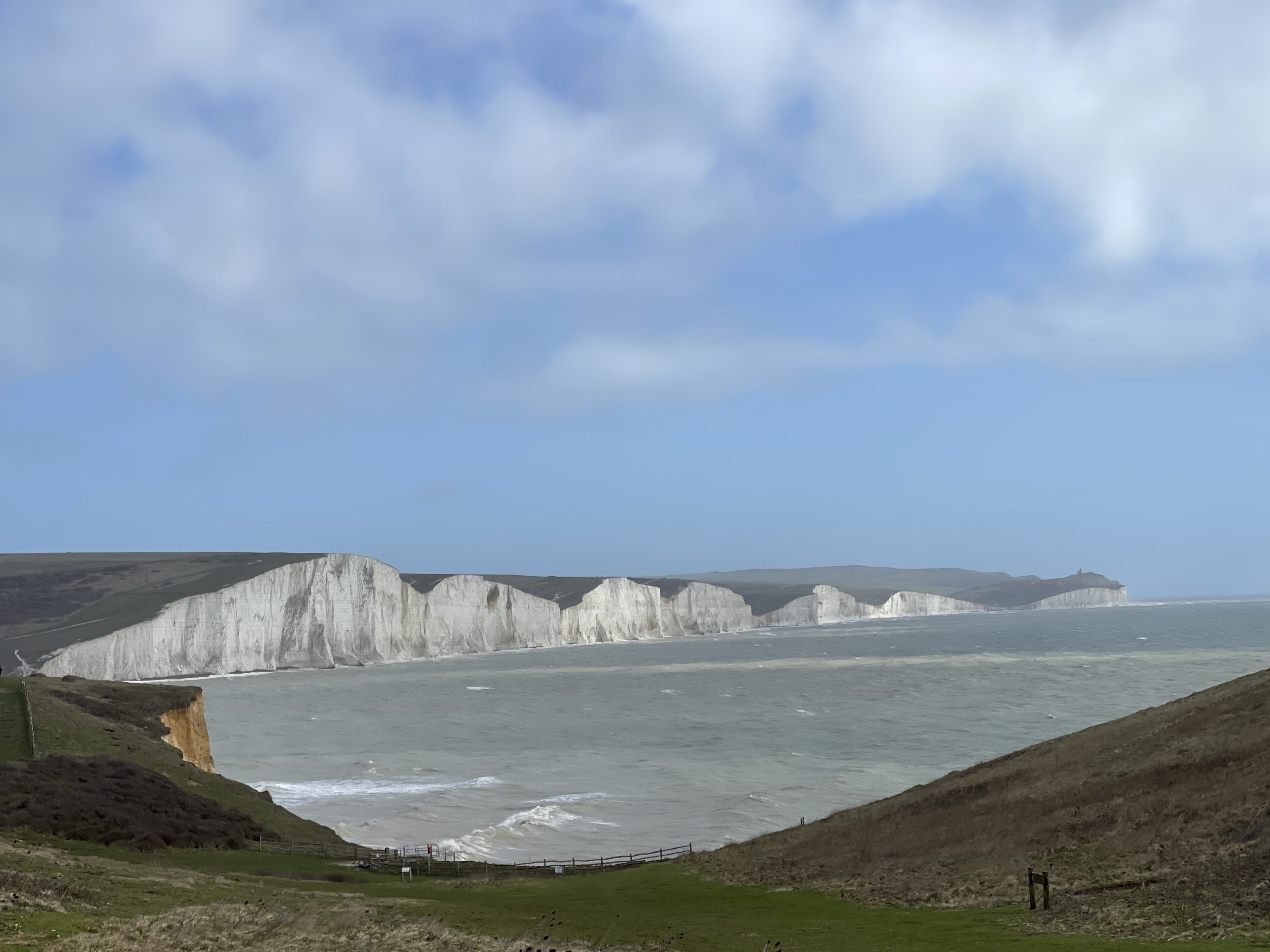
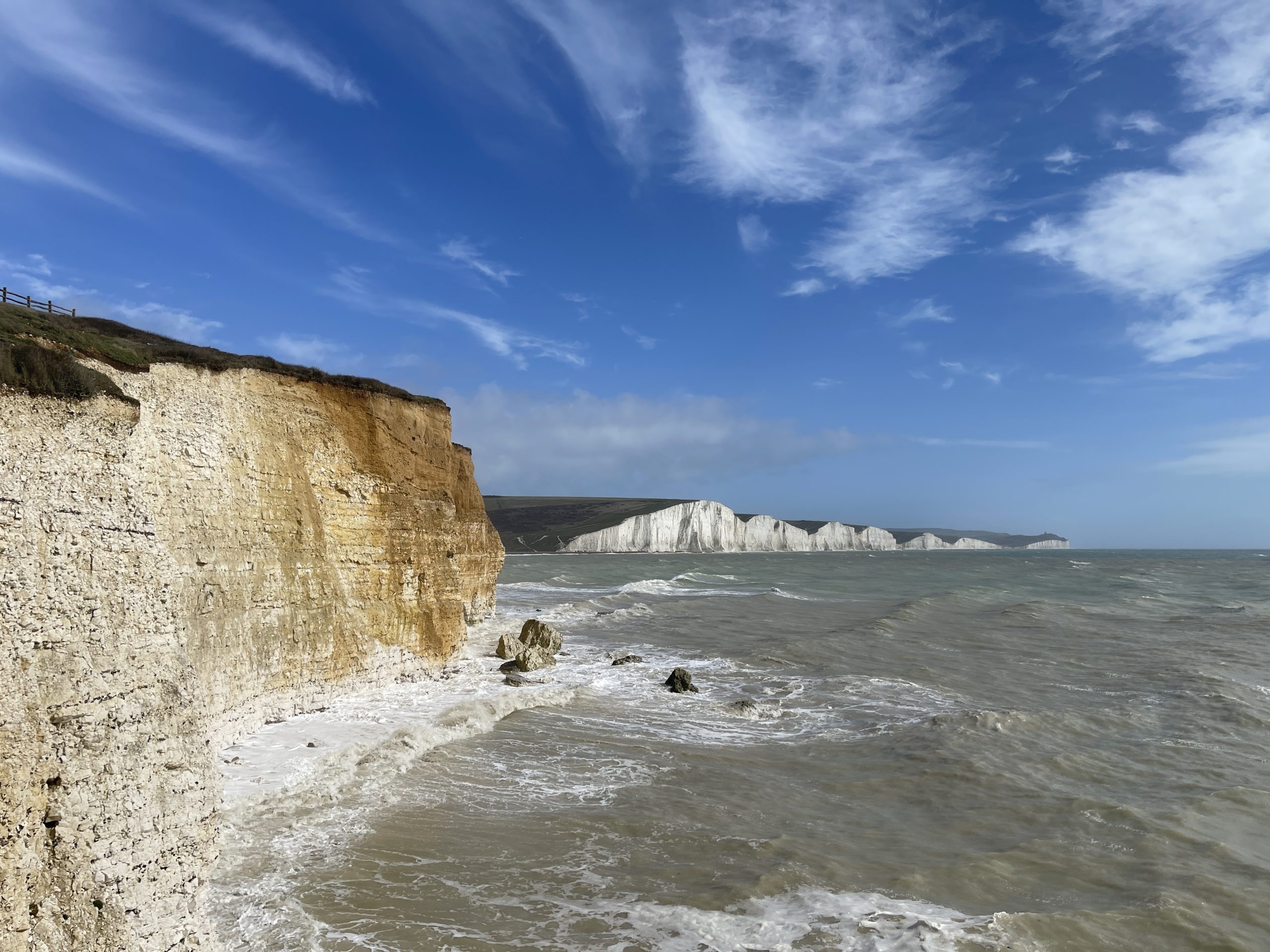
An inspiring, new immersive walking experience that encourages visitors to discover new stories and reflections on Sussex’s iconic Heritage Coast has now officially launched. This summer, people walking along the beautiful chalk coastline from Seaford to Eastbourne will be able to tune in to 13 unique audio stories, each attached to a ‘listening point’ in the landscape, such as a bench, gate post or signpost.
We Hear You Now: the audio content includes stirring, emotive and sometimes surprising stories covering fiction, poetry and even new mythologies for this world-famous coastline. The talented wordsmiths have worked in collaboration with Alinah Azadeh, project lead and the first-ever Writer-in-Residence for Seven Sisters Country Park and Sussex Heritage Coast.
Alinah explained: “My intention is that our stories and poems act as a welcome, a creative spark – and a marker of radical hope in these precarious times.
“I wanted to make space both for my own work as resident writer and to amplify other creative voices missing from this pastoral coastal landscape; older women’s voices, Black voices, voices of colour, migrant voices, queer and non-binary voices, working class voices, disabled voices.
“Many of us have centred the most crucial voice of all; the voice of the land, and its challenge to us to reciprocate the care, protection, spaces for rest and joy it has always given us.
“Thank you to the close partnership and unswerving support of the South Downs National Park, and all the writers and spectrum of partners in making this new immersive walking experience possible.” The experience begins at the Seven Sisters Country Park Visitor Centre, near Seaford, and leads the visitor around the meanders and river of Cuckmere Valley. Then you are taken along the breathtaking chalk coast via Belle Tout Lighthouse and Beachy Head. Visitors can sit and hear the stories, or walk with them. The audio stories are accessed via any smartphone by simply scanning a QR code or tapping for an NFC code.
The writers are Alinah Azadeh, Georgina Aboud, Jenny Arach, Razia Aziz, Joyoti Grech Cato, Oluwafemi Hughes, Dulani Kulasinghe, Georgina Parke and Akila Richards. Access the video here:
Anooshka Rawden, Cultural Heritage Lead for the South Downs National Park, said: “Exploring the landscape with ecologists, archaeologists and environmental campaigners, British-Iranian writer and artist Alinah Azadeh, has used her passion for the South Downs to provide a nurturing hand to fellow creatives who have been invited to voice their relationship with the Seven Sisters and the Sussex Coast.
“In We Hear You Now, writers of global heritage bring stories of survival, recovery and reverence for land as a living, breathing entity to create new mythologies for this iconic landscape. I hope anyone who listens to this new immersive walking experience feels closer to the land under their feet, and to the people and cultures who have been part, and continue to be part of its future.”
The trail launches to the public on 24 June 2023. Print guides with a map and information can be collected from Seven Sisters Country Park Visitor Centre, Exceat, near Seaford, East Sussex, BN25 4AD and across partner sites, or downloaded online from 24 June 2023. All content is freely available.
Our latest Walks and Strolls programme for the third quarter is now live. We offer over 200 walks and strolls over the year of varied distances for most fitness levels. Centenary celebrations continue this quarter with themed strolls in various locations.
The first one takes place in August and begins in West Chiltington, after which participants will enjoy lunch provided at the Society’s Pulborough office. The second Centenary stroll takes place near Petworth and our patron, Lord Egremont, has granted exclusive access to the private wood at Flexham Park. The third Centenary stroll will actually be two separate strolls on the same evening, aiming to meet up at Devil’s Jumps near Cocking to enjoy the sunset.
One of our trustees, David Green, has designed a linear walk called the ‘Belloc Way’. The route draws inspiration from Hilaire Belloc’s renowned 1911 novel, The Four Men: A Farrago. The novel recounts the journey of four men who embark on a 90-mile pilgrimage across Sussex, starting from Robertsbridge in the east and concluding at South Harting in the west. Along their path, they encounter various points of interest and engage in sharing stories, songs, jokes, and reflections on life, history, and culture.
The ‘Belloc Way’ walk will take place over six days during the first two weeks of August. While four committed regular walkers have pledged to complete the entire route, we warmly welcome other participants to join them for individual legs of the journey. This will provide an opportunity to learn more about Belloc’s remarkable life and his significant contributions to the literary world.
As well as our Walks and Strolls programme, we also offer a selection of self-guided walks which you can enjoy on your own or with friends. For each walk we provide a download including a map, description and images to help you find your way.
Most readers will instantly recognise these lines from the poem Sussex by Rudyard Kipling. Few poems capture the spirit and the beauty of the Downs which he had come to love at the turn of the 20th Century. It was written in the summer of 1902, just a couple of months before he and his family moved from Rottingdean, where they had been living for the past five years, to Bateman’s near the East Sussex village of Burwash, where they would live out the rest of their lives. They had moved to Rottingdean in 1897 at a time when he was one of the most popular and admired writers in the country, having captured the public’s imagination with his tales and poems of India which had earned him the soubriquet ‘The Laureate of the Empire’.
Overall, the Kiplings’ stay in Rottingdean appears to have been a happy period in their lives, although clouded by the death of their eldest child, Josephine, who had died of pneumonia at the age of just six years old whilst they were on a visit to America in 1899. Looking back at their time in the village, writing in his autobiography Something of Myself, Kipling recalled, ‘I do not remember any violent alarms and excursions other than packing farm-carts filled with mixed babies […] and despatching them into the safe clean heart of the motherly Downs for jam-smeared picnics, […] Those were exceedingly good days, and one’s work came easily and fully.’
However, the Downs that Kipling eulogised in his poem were in a state of crisis. From the 1870s onwards, Britain had experienced a prolonged agricultural depression, brought about by cheap imports of wheat, meat and wool from abroad. Land prices had plummeted and by the beginning of the 20th Century much of the downland lay derelict. However, where many saw crisis others would see opportunities. In 1915, a property developer called Charles Neville bought up land on top of the cliffs west of Newhaven, and after the war, divided the area up into plots of land for people to build their own houses on. With virtually no planning restrictions, the new ‘town’, which was given the name ‘Peacehaven’, was described as ‘a rash of bungalows, houses, shops, shacks, chicken runs, huts and dog kennels’.
The despoilation of the Downs at Peacehaven was, of course, the spur that led to the foundation of the Society of Sussex Downsmen (as it was then known) in 1923. Its first chairman was the journalist and newspaper proprietor, Arthur Beckett. At the Society’s inaugural meeting in January 1924, Beckett proposed that, ‘Mr Rudyard Kipling be asked to be President, or failing that, Patron of the Society.’ Kipling was a notoriously private person, and nothing appears to have come from Beckett’s proposal.
However, whilst he may have shunned the idea of an honorary post in the Society, Kipling obviously felt deeply about saving the Downs from development. In 1926, the Crowlink Estate, which comprised 480 acres of land along the top of the Seven Sisters cliffs between Seaford and Eastbourne, was bought by a building syndicate for £9,750. In an effort to prevent development taking place, the Society approached the syndicate to buy the land to protect it. The syndicate offered to sell the land for £16,450 so a national appeal was launched to raise the money. As part of the appeal, a leaflet, entitled, ‘The Beauty of England must mean something to you!’ was printed to publicise the campaign. The leaflet describes the beauty of the Downs and states: It might have been this very beauty that inspired Mr. Rudyard Kipling when he wrote the fourth stanza of his Sussex:
Clean of officious fence or hedge,
Half-wild and wholly tame,
The wise turf cloaks the white cliff-edge
As when the Romans came.
What sign of those that fought and died
At shift of sword and sword?
The barrow and the camp abide,
The sunlight and the sward.
It is just this ‘wise turf’ and this ‘white cliff edge’ of Crowlink that have been threatened with defacement in our commercial age.
These lines could only have been printed with Kipling’s permission, and by allowing his lines to be quoted he would have added much weight to the appeal. The appeal caught the public’s imagination and the necessary funds were swiftly raised whereupon the Seven Sisters ultimately passed into the guardianship of the National Trust. In addition to Kipling lending his name to the appeal, Arthur Beckett writing in an article for The Sussex County Magazine shortly after Kipling’s death in 1936, tells us, ‘When I asked him if he would subscribe to the purchase fund initiated by the Society of Sussex Downsmen to save the Crowlink Valley […] he sent a cheque for a substantial sum.’ Kipling’s involvement in the appeal clearly demonstrates his concern over development that was taking place in an area of countryside that he had come to love.
Although the Seven Sisters had been saved, insensitive development would take place on the cliff tops to the east of Rottingdean. In his autobiography, whilst remembering the happy times at Rottingdean, Kipling regretfully observed, ‘Today, from Rottingdean to Newhaven is almost fully developed suburbs, of great horror.’
It is evident that Kipling loved the Downs and was happy to do what he could to protect them, whilst his evocative poem Sussex would go on to inspire others to go out and do the same. His role in the campaign to save the Seven Sisters undoubtedly contributed towards the success of the appeal and in many ways, he was in the vanguard of what today we would call the conservation movement.
Richard Howell
Richard Howell is a Council member of the Kipling Society. He lives in Sussex, and has recently completed an M.A. thesis on the history of the Bateman’s Estate.
The Friends of the South Downs are appealing to young people in Sussex and Hampshire to write about the South Downs, either as a short essay or a poem. Chris Hare, project manager for ‘South Downs for All,’ a project funded jointly by the National Lottery Heritage Fund and the Friends of the South Downs, aimed at teaching school students about the heritage of the South Downs, is currently working on a lavish picture book, A Year in the Life of the South Downs, that will show the landscape in all its different forms and moods over a twelve month period.
Chris at Cissbury Ring
As Chris explains: “We photographed the downland landscape under the influence of the four seasons, from snow dusted hill tops, through bluebell woods in spring, to summer wheat fields and the red and golden leaves of autumn. We also photographed human activity across the year, such as the World Marbles Championship at Tinsley Green at Easter, to Lewes Bonfire celebrations in November. We have the photographs, all we need now are the words!”
As ‘South Downs for All’ is focused on working with schools, the project team felt that it is the children who should provide the words for A Year in the Life of the South Downs, rather than being written by Chris or other adults working in the field of heritage.
“I could write about the history of the downs for A Year in the Life of the South Downs and the traditional activities that take place there,” Chris explains, “as could many other South Downs authors, but the children are our future and they will be custodians of this wonderful landscape in the years ahead, so we want to know what the feel and respond to the South Downs – landscape and people.
Sheep Fair
Chris says that they are primarily looking at responses from children aged 8 – 12, but they will consider submissions from any school-aged children. Essays and poems should be no longer than 300 words and can be on any theme that has a South Downs connection. To help inspire young writers, the South Downs for All website has a gallery section of photographs, set out under seasonal headings. It is hoped that looking at these photographs will act as a prompt to imaginative thoughts.
Any young person whose work is included in the book will be fully acknowledged, including their name and town or village of residence. They will also receive two free copies of the colour, hard-backed book and an invitation to the launch event which will probably take place in late November this this year.
All entries should be submitted to Chris Hare by 31 May 2023 at chris.hare@friendsofthesouthdowns.org.uk All enquiries about the project should be mailed to Chris at the same email address.
Our Centenary year in 2023 provides a great opportunity to celebrate the South Downs and the role of the Friends of the South Downs, and to publicise what we do. To mark our Centenary year we are planning significant events and activities to celebrate the beginnings of the Society.
It’s difficult to imagine a world in which people could build without restriction on a landscape of outstanding beauty, yet that is the threat that our predecessors faced almost 100 years ago.
After witnessing the construction of Peacehaven on the chalk cliffs to the west of the Ouse, our founder members feared what would happen to the rest of the eastern Downs in that time without effective planning controls. To counter that threat they joined together in 1923 to form ‘a society for the preservation of the Downs’, which soon became the Society of Sussex Downsmen. We later changed the name to the South Downs Society and are now known as the Friends of the South Downs.
‘One spring day in 1923 on the chalk cliffs overlooking the Channel, two men, brothers-in-law, walking east from Brighton, were dismayed to come upon the new settlement of Peacehaven, developed on what was once downland. There was only rudimentary town planning in the 1920s and Peacehaven had been sold in plots, with no control over the dwellings to be built on them. It was no more than a shanty town.
‘Their day doubtless spoilt, Robert Thurston Hopkins and Captain Irvine Bately returned to their homes in Brighton resolved to try to prevent any further loss of the precious landscape of the Sussex Downs. Thurston Hopkins made contact with Gordon Volk. A committee was formed comprising Robert Thurston Hopkins, his wife Sybil, Captain Irvine Bately, his wife Lilian, and Gordon Volk. Volk then approached Arthur Beckett, a prominent newspaper owner. Beckett agreed to become President of the new society. Late in 1923, a crowded public meeting in the Royal Pavilion enthusiastically resolved to form a society for the preservation of the Downs.‘ Excerpt from Richard Reed’s A Centenary History of the Friends of the South Downs.
The threats to the Downs may have changed over the last 100 years but we still remain vigilant to protect the natural beauty of the area. To mark our Centenary year we are planning these significant events and activities.
South Downs for All: a two-year lottery-funded project to encourage children to know and love the Downs. We’re working with two secondary and six primary schools to take children on field trips on the Downs. The schools chosen have higher than average less well-off and ethnic minority children: groups which are less likely to visit the great outdoors.
A fascinating new book on the history of the Friends. Written by Richard Reed, who has been a member for a remarkable 75 years, the book traces our history from the struggles of the 1920s when there were few planning controls to the challenges of today. The book is available to all members and available to purchase on our website.
Stimulating talks by prominent personalities. We have arranged tremendous online talks in 2023 by
Hilary Benn, the Labour Member of Parliament for Leeds Central who, in 2009, signed the order confirming the designation of the South Downs National Park. Register here!
Alistair Appleton, television broadcaster (Escape to the Country), psychotherapist and meditation teacher at Mindsprings in East Sussex
Isabella Tree, award-winning author of Wilding who, with her husband Charlie Burrell, run the rewilding project at Knepp Estate in West Sussex
Recreation of Hilaire Belloc’s Four Men walk We will walk in the summer of 2023 perhaps one of the first long-distance trails, Hilaire Belloc’s route from Robertsbridge to South Harting. We’re also thinking as well of ways to make the walk better known.
Making a length of footpath more accessible We plan to improve a selected footpath to make it accessible for wheelchair users. We’re still working out the details of the best site to choose and will keep you updated.
A cycling festival Cycling, particularly with electric bikes, can help people access suitable routes on the Downs. We are working with selected bike shops this summer to run events near the South Downs Way to demonstrate and try the latest regular and electric bikes.
Centenary appeal Would you like to help these exciting events and projects happen? Please get in touch. We’d love to hear from you!