
Posted on

The Great South Downs Sit Down

View from the newly-installed Saddlescombe Bench

Many walkers tell Friends of the South Downs that there is very little provision to sit down and rest along the South Downs Way, which runs from Winchester to Eastbourne. Today, 19 May 2021, marks the day we proudly reveal the first bench in our ongoing project to provide seats at intervals along the entire length of the iconic route.

The first bench has been installed at East Hill above Saddlescombe Farm on National Trust land. FOSD Patron Lord Egremont cut the ribbon to launch the campaign. Vice-Chairman Andrew Lovett addressed the assembled group of representatives from the NT, South Downs National Park Authority and Trustees of FOSD, at a small, Covid safe, celebration.

Chainsaw sculptor Chris Bain / Photo by Dan Fagan – National Trust

After first gaining permission from the South Downs National Park Authority, we turned to the National Trust, as a major landowner along the route, to provide the initial sites. The first benches are being carved by local chainsaw sculptor Chris Bain. Each bench will be made of sustainable, locally sourced oak and feature a small hidden downland creature. Benches will be individually designed to blend into and enhance the setting in a sympathetic way.

Caroline Douglas, the FOSD Trustee leading The Great South Downs Sit Down project, said, “we are so grateful to Jane Cecil, the NT General Manager and the NT Rangers for all their help and enthusiasm in getting this project off the ground and to Chris Bain for producing such a beautiful bench. More progress has been made with finding sites, so watch out for other benches appearing over the coming months.”

When you visit one of our benches, please share pictures onto our Facebook or our Twitter page! If you find any spots along the South Downs Way that might be a perfect place for one of our benches, please contact us.

Bench dedication ceremony, 19 May 2021. Photo credit: National Trust
Posted on

Cycling in the Downs

Have you ever thought of doing sections of the South Downs Way on your bicycle?

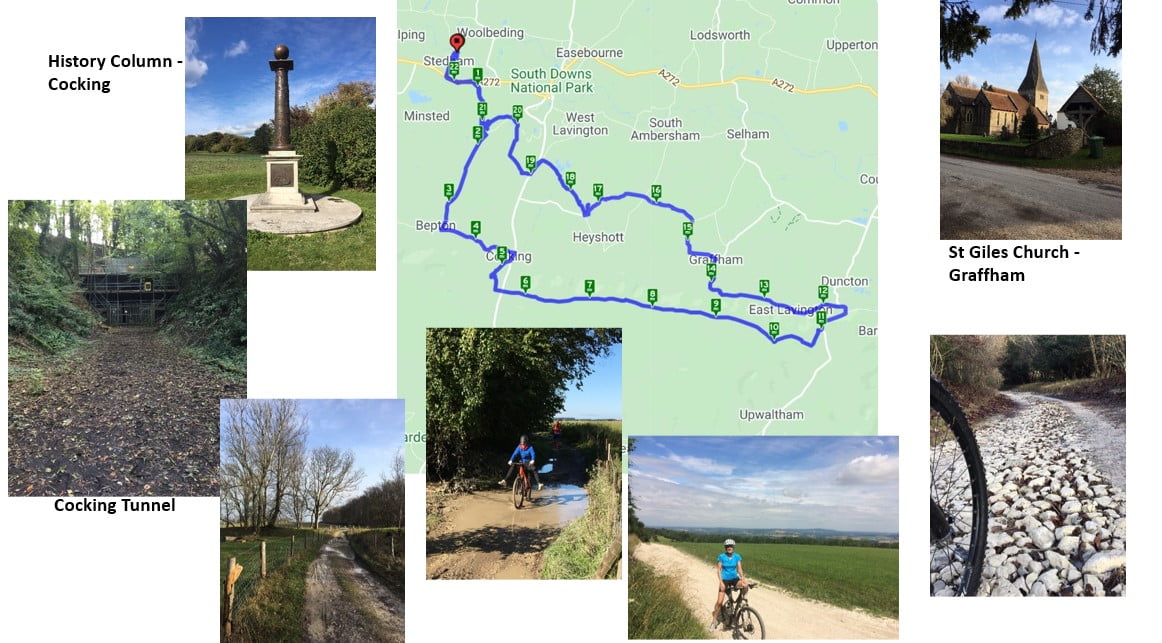
For anyone not so keen on the uphill sections there are electric bikes available for hire in a number of towns located close to the South Downs Way. Midhurst is the recommended start point for this 20 mile roundtrip. E-Bike Adventures e-bike hire service and All Ride Now e-bike shop in Midhurst can help there.

From the hire shop, it’s just a short distance until you reach the turning for Bepton and you are then on a quiet country road running alongside Midhurst Common and out into open countryside. The route passes through Cocking and then up to the South Downs Way via Crypt Lane. Look out for the Time Column in Cocking and (disused) railway tunnel which hopefully will one day become part of the Centurion Way.

After crossing the A286, it’s a slow steady climb up the South Downs Way, but there’s plenty of reason to stop to admire the view to the West and North. You now have 5 miles of South Downs Way to enjoy. There’s dense woodland on your right and grazing pasture, ancient tumulus and plenty of places designated as SSI opposite. You reach a height of 234M at the intersection with the path to East Dean to the south and Duncton to the North. The views to the North East and West even on a dull day are fantastic. A short detour from here to Tegleaze Crown will take you to the highest point on the South Downs in Sussex at 255M. It’s downhill from here to Duncton via the quarry and A285. Check your brakes before you freewheel down and make a stop at the overview point at Fryan’s Hanger.

At the bottom of Duncton Hill after the 2 sharp lefthanders, turn left into Beechwood Lane. In ¾ mi, you’ll find a small gate on the right leading into Seaford College. Turn left and pass through the school grounds and along the track with Lavington Stud Farm on your right and pass the gatehouse. A right turn will lead you to St Giles Church, Graffham and on down the hill into the old part of the village.

Follow signs for Heyshott/Midhurst until you reach Heyshott Common. Follow the sign marked Footpath to Dunsford (the former home of Richard Cobden). Pass Canine Partners and along the path to Dunsford and up the road to Pendean. You arrive at Oaklands Lane where you turn right passing over the disused railway to Pulborough until you come to Church Road on the left. It’s a short sharp rise but you’ll sense refreshments are (hopefully) just a few minutes away so it’s little bother. From Church Road turn left onto Selham Road and it’s a few hundred yards down to Chichester Road and South Pond in Midhurst. For your well-earned coffee and cake the time will come again to try Gartons in the Market Square. The time will also come again when there are plenty of pubs for something stronger.

Chris Steibelt, Trustee

Posted on

Planning Update for Hampshire Festival

Click to enlarge

An organisation has applied for planning permission in the South Downs National Park between Alton and Bordon.

This planning application concerns a site off the B3004 in the parish of Worldham. Application details:

SDNP/19/03709/FUL  Change of use of Oakland Farm and associated land holdings from Agriculture and B8 (Open Storage) to mixed use Agriculture, B8 (Open Storage) and Seasonal Event Space associated with the holding of a Religious Festival associated with the Ahmadiyya Muslim Association; alongside the provision of external storage space, new landscape and revised ventilation. To fine out more or to comment of the application go to:  https://planningpublicaccess.southdowns.gov.uk/online-applications/ and put the reference in the search box: SDNP/19/03709/FUL

Background:

This application follows the withdrawal of application SDNP/18/02170/FUL previously under-determination by the South Downs National Park Authority (SDNPA), and the officer’s recommendation for refusal. The event is currently run under the 28 day rule for agricultural properties. So far there have been over 120 objections to this latest application. The previous application attracted over 170 objections. The application is seeking to extend the period of the event to 7 weeks, of which 4 days would be for the event, with the remaining time taken for erection and dismantling of the site infrastructure. In addition it seeks to increase attendance to a maximum limit of 50,000.

The planning application states:

  • The Application site is 74ha, and lies adjacent to two SSSIs and a SAC.
  • The festival, known as the Jalsa Salana, is organised by the AMA and is usually held in the UK, every year, on or around the last weekend of July. The recent number of participants is assessed at 38,000, with people attending from more than 100 countries.
  • It is envisaged that the overall vehicle attendance for on-site parking as a whole will not exceed 3,900 per day on the basis of the measures that have been taken by the AMA to maximise the use of contracted coaches and public transport. Further parking is made available for up to 5000 vehicles at Country Market, a small retail park some 3 miles from the event site with buses laid on for transport to the event site.
  • Currently, the gathering extends over three days, beginning on Friday after the Friday Sermon, with site construction and dismantling taking and additional 25 – 30 days.


Posted on

Proposed new building regulations not ambitious enough in reducing CO2 emissions!

Towards the end of 2019 the Government consulted on Changes to Part L and Part F of the Building Regulations. This consultation set out the Government plans for the Future Homes Standard to be introduced by 2025.  It is the first stage of a two-part consultation about proposed changes to the Building Regulations. Sounds pretty boring stuff doesn’t it? However in reality It one of the key areas which need to be dealt with in order to tackle climate change.

The Friends of the South Downs have responded to the consultation which ended in February 2020 asking the Government to ramp up their efforts to meet their own climate change ambitions by re-writing the proposed standards to introduce zero carbon homes by 2025.     CLICK HERE  to is see our response to the consultation.

Professional organisations are also also asking for major improvements in meeting climate change targets, for instance the Chartered Institution of Building Services Engineers (CIBSE) say: “The CIBSE very much agree with the stated overall ambition described in the Consultation Document, but have strong concerns that the proposals set out are not sufficiently ambitious to deliver significant progress towards meeting the objectives of reducing carbon emissions, annual energy consumption and peak demand, and ensuring affordability to consumers. The proposals for Part L 2020 do not represent the required “meaningful and achievable step” towards zero carbon, and the timeline and content of the Future Homes Standard is not ambitious enough, nor does it begin to address real in-use energy performance and carbon emissions”.


Click this image to read the the Government’s own Committee on Climate Change in report to Parliament in 2019


The need for a more ambitious stance on tackling climate change is desparatly needed. For instance the Government’s own Committee on Climate Change in their report to Parliament in 2019 confirmed that buildings account for 17% of all greenhouse gas emissions in the UK (see page 85).

Our Society’s report not only asks for zero carbon homes standards by 2025 but we also say:

  • In the context of a Climate Emergency, the proposed options for 2025 are not nearly ambitious enough and could actually result in a retrograde step.The Intergovernmental Panel on Climate Change (IPCC) report (Oct18) makes it clear that it is now urgent that we reduce carbon emissions, stating that we have less than 12 years to stop climate change. Even the introduction of the proposed 31% uplift (option 2) does not go nearly far enough to reduce energy demand in buildings if we are to achieve Net Zero by 2050 or earlier.
  • We must retain the powers of local authorities to set higher requirements than national standards where practical and demonstrably viable, particularly those councils that have declared a ‘Climate Emergency’.  Where local conditions allow, we believe that Local Authorities and National Parks should be able to set higher standards.  As with all development, any Local Plan policy is subject to viability tests and thus, allowing LAs to set higher standards does not restrict development.

We understand the results of the consultation will be announced later in 2020.

Posted on

‘Dreadful’ design for former Auction Rooms in Garden Street, Lewes with no affordable homes

Our volunteer District Officers (DOs), Liz Thomas and Jennifer Chibnall, spoke at the National Park planning committee meeting earlier in March 2020 against a proposal to build large glass and timber clad tower houses on this site which was allocated in the Lewes Neighbourhood Plan to meet local housing need.  The National Park planning officers had recommended the proposal be accepted even though the development didn’t include any affordable housing. The expensive ‘novel’ design was offered as reason why none of the houses could be affordable.  Liz Thomas drew attention to the precedent set by a High Court case in London which rejected such building on sites that has been designated for affordable housing.


There was much criticism of the design, in particular from the chair of the Planning Committee, both for its unsuitability in this Lewes Conservation Area and it being so expensive in its construction that the applicant argued this precluded affordable housing.  As a result, the officer recommendation was rejected unanimously by the committee, and the application refused. Click the links below to see our DOs in action and the Chair’s excellent dissection of Conservation Area purposes.  He held that any development in a Conservation Area, must respect and reflect the original reasons for the designation saying –  it was not sufficient to argue a development was “good architecture” in isolation and it must be framed by the reasons originally set out for the area to be conserved.

Click on their namehere  to see Jennifer Chibnall and Liz Thomas in action

Posted on

Design Consultation: new development of 226 homes at Old Malling Farm Lewes

Local Lewes councillors and the Friends of the South Downs (South Downs Society) called on the developer to reduce the over provision of parking for each property on the site but called for on street parking restrictions to prevent commuter parking causing problems for the new householders. There is already local concern as nearby is the HQ for both the Police and Fire Services.  The Society also called for

  • Improved cycling and walking links to Lewes town which is only a short distance away.
  • A better design to compensate for the loss of biodiversity and ecosystem services at thid greenfield site.
  • A pedestrian crossing on Old Malling Way –  via a ‘Grampian-style’ condition (meaning it would happen before the wider development begins).
  • Provision of zero carbon houses, – the design brief layout must cover the type of heating to be used. If solar panels are to be used, the layout needs to addressed from the outset

Consultation on the design brief has now closed, but more details of the proposal can be found by searching for the reference SDNP/DBC/SD76 on the South Downs National Park planning portal. Consultation on the wider outline application is still active, however, with more details available by searching for the reference SDNP/18/06103/OUT. For more information go to: https://www.southdowns.gov.uk/old-malling-farm-design-brief/

The Society’s response was prepared by our Lewes Town volunteer District Officers – Liz Thomas and Dr Jennifer Chibnall – click below to read the document:

SDS Response to SDNP Design Brief Consultation March 2020


Posted on

How do we stop bad planning??

Help need to keep a watch on planning applications! ………………………………..

Our Society were keen campaigners for the creation of the South Downs National Park which came into being in 10 years ago.  The new National Park designation theoretically provides the highest planning protection. However, having this protection doesn’t mean to say our countryside is safe. We are in the crowded south-east of England and there is constant pressure on the South Downs for new land developments. For decades the Society has tried to ensure that this 100 mile stretch of iconic and naturally beautiful landscape covering an area of over 400,000 acres (1.6K hectares) is conserved and enhanced, whilst protecting wildlife and cultural heritage.

How do we, in our Society,  go about ensuring the Park will survive for future generations to enjoy it? Well, any new development must have planning permission and we monitor new planning applications. Some may not be in accordance with the National Park purposes, so we lobby and/or comment to the Park. We do this through a team of volunteers who keep a check on applications in their local area and raise any problems or issues with the Society’s Policy Officer who then takes the matter up with the National Park.

Why is this important? Because, once a planning permission is given there is virtually no way of undoing it so it’s good to catch these things early and convince the officers and members of the National Park to consider our comments aimed at protecting the Park.

We make no bones about it; it’s difficult keeping an eye on the thousands of planning applications across the Park in all of its 176 parishes. The South Downs National Park Authority processes far more planning applications than any of the other 15 national Parks in Great Britain. However, we believe we’ve made it easy for people to volunteer a little bit of their time to check planning applications on a weekly or monthly basis. We have divided up the area of the Park into about 25 small ‘districts’. Each volunteer checks on their own district. This only takes an hour or two a week. Our office circulates the planning lists to all our committee members and the ‘District Officer’ just has to look for the ones on his/her patch and send in an email with a note of concern to our office. Basically, that’s it!

One can do as little or as much as you want to help. If you want to join our network please CONTACT US.

Posted on

Appeal against enforcement by shooting organisation at Iford near Lewes

Iford Shoot Appeal Hearing

Extract from the appellant’s submission showing the shooting plan: The South Downs Way runs through this area. (more details in our report) see also sketch map below.

The battle to protect the South Downs by local communities against the expansion of commercial shooting on the Downs near Lewes took another turn last month. Despite previous planning action by the local council, commercial shooting on the Downs near Lewes has continued over the last 10 years. Lewes District Council (on behalf of the SDNPA) issued an enforcement notice on 14 August 2018. This then generated an appeal which was heard by the government’s planning inspector at a hearing on 10 March 2020 in Lewes.

The game shooting organisation had legal counsel and a planning consultant present. The SDNPA case was put by the local Enforcement Officer from the Lewes District Council and a South Downs National Park Officer who put forward some points in favour of the enforcement case.  The owners of Breaky Bottom Vineyard engaged a barrister who was a key figure in putting the alternative case to the inspector against the expansion of shooting beyond the 28 days legal limit. The Friends of the South Downs were represented by one of their local volunteer District Officers, Brian Davies, who spoke at the hearing giving evidence against the expansion of commercial shooting.

There are some concerns about the lack of fair and proper public notifications of the appeal hearing , the proximity of shooting activities to public rights of way, the noise of shooting disturbing the tranquillity of the Downs, the effect on the flora and fauna of the area, the use of the National Parks Whole Estate Plans in making out a case for shooting and the impact which such intensive activities have on the nearby villages and their residents.

Commercial Shooting activities at this location are at odds with a number of the policies of the South Downs National Park including:  Landscape Tranquillity Policy (SD7), Landscape (SD4), Biodiversity (SD9) and Section 6B, – Enjoyment of the National Park and it’s policy SD23.

The decision by the Government’s Planning Inspector will be announced in the next couple of months. 

The image above is approximate in the centre of this sketch map.


Posted on

210 homes development given the go-ahead at the former Syngenta site, Henley Old Road, Fernhurst

Our Society has always supported the principle of development for housing on the former ICI brownfield industrial site (more recently called Syngenta) just outside the village of Fernhurst, north of Midhurst. Together with Fernhurst Parish Council we have successfully campaigned for a continuous path to connect this site with the main village. There are a number of good features about this development, however we are disappointed that there are only 20% of affordable homes being allocated for this site. 

This site was specified as an ‘exemplar renewable energy’ site in the National Park Local Plan . Out of the 210 homes 140 have been given permission to have wood burning stoves.  Both Fernhurst Parish Council and the Society had campaigned against this, as we were concerned about the pollution from PM2,5, which is emitted by them and has been identified by the World Health Organisation as the most serious air pollutant for human health.

Posted on

Countryside development up a narrow lane rejected at Selborne Road, Newton Valence, Alton

At the SDNPA Planning Committee meeting in March 2020. There was much criticism of this scheme from the members of the Planning Committee and it was unanimously rejected by them, despite planning officers having recommended approval.

Our Society has previously asked the National Park not to take into consideration Whole Estate Plans (WEPs) when considering planning applications.  WEPs are not a statutory planning instrument and are unique to the SDNPA.  They do not undergo any formal public scrutiny process before they are approved by their Policy & Resources Committee. In this case  the South Downs National Park had endorsed a WEP previously for this estate.